Showing posts with label 19th illustrated books. Show all posts

September 24, 2010

Claude Terrasse and Pierre Bonnard : a family spirit

Claude Terrasse (1867-1923) met the Bonnard family through the eldest son Charles, while doing civic service time. In 1890 he married Andrée Bonnard, also a musician. The couple moved to Arcachon where Terrasse is a piano teacher. He worked very early with his brother in law, the painter Pierre Bonnard. At that time, is published Petites Scènes Familières pour Piano (Familiar Little Scenes for piano). Pierre Bonnard takes pleasure in playing with the austere chromatic of lithography while Claude Terrasse already demonstrates his talent as a composer of light music with 'La fête au village" (the village party), set of four humorous partitions.
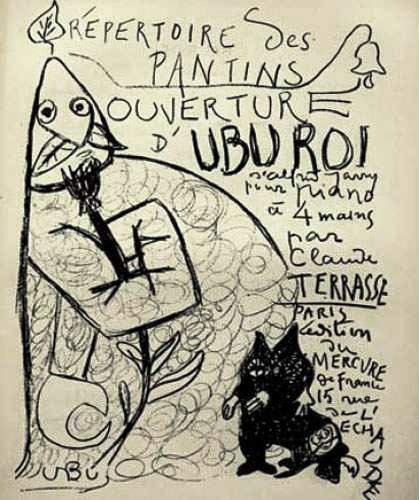
Appointed in Paris in 1896, Claude Terrasse uses the workshop adjoining his apartment to create the Théâtre des Pantins (puppet's theatre). All the Parisian artistic avant-garde is involved in this adventure. Claude Terrasse continues to work with Alfred Jarry for whom he has just composed the music for Ubu Roi, whose first representation made scandal. In 1898, is published Repertoires des Pantins (Puppet's repertory) which includes the songs created for the Claude Terrasse's puppet theatre. In this set of nine booklets, illustrated with six original lithographs by Bonnard, one can find the opening of Ubu Roi and the famous "Song of brainwashing" (full text here.)


Currently, the librairie Loliée offers :
  • Bonnard (Pierre) - Terrasse (Claude). Petites Scènes familières pour piano. Illustrations de Pierre Bonnard. Paris, Fromont, s.d., huge in-4, half-levant binding, folder and case (Alain Devauchelle). Rare music sheets by Claude Terrasse, illustrated with 19 charming original lithographs by Pierre Bonnard.
  • Bonnard (Pierre) - Jarry (Alfred) - Franc-Nohain - Terrasse (Claude). Répertoire des Pantins. Musique de Claude Terrasse. Lithographies originales de Pierre Bonnard et Jarry. Paris, Mercure de France, 1898, 9 booklets in-4, folder and case. 6 original lithographs by Pierre Bonnard et 3 by Alfred Jarry illustrate the music of Claude Terrasse.

July 01, 2010

Raffaëlli and Mallarmé "Guys"

French painter of Italian origin, Jean Francois Raffaelli (1850-1924) who studied with Jean-Léon Gerôme at the School of Fine Arts, began his career at the Salon in 1870. In 1884, he got his own exhibition on the theme of scavengers and petit bourgeois. He used to visit the "grenier" of Auteuil, a town house where Edmond de Goncourt continued to receive authors and artists after the decease of his brother. In 1888, Raffaëlli offered to Stéphane Mallarmé to collaborate on Les Types de Paris (Guys of Paris), a collection he illustrated. He sent his work to Mallarmé who wrote then in regard of the drawings. The poems were published for the first time in the issue n°7 under the title "Types de la rue" (Street guys). A total of 22 authors among whom Daudet, Zola, Maupassant, Huysmans, Mirbeau, participated in this project realased by Les Editions du Figaro.

Currently, the librairie Loliée offers:
  • [Raffaëlli (J.-F.)] - Collectif. Les Types de Paris. Paris, Plon, Nourrit et Cie, 1889, in-4, 10 booklets in-4, case. First edition. Many in text drawings, some in colors, by Raffaëlli. Delivery issues in perfect condition.

April 01, 2010

Salammbô illustrated by Rochegrosse

Georges-Antoine Rochegrosse (1859-1938) grew up surrounded by artists and man of letters. His widowed mother remarried the poet Théodore de Banville, then in the top of his celebrity.
In the family apartment, the young Rochegrosse met with the intellectual elite of the time: Théophile Gautier, Charles Baudelaire and the Parnassians whom Banville is one of the leaders. From childhood, he liked to draw and his sketches are subjected to passing friends. Gustave Flaubert, charmed by a set of views of Carthage, said incidentally :
- Once you have the talent, I'll order you the illustrations of Salammbô.

This remark as a joke come true though 25 years later when the publisher Ferroud inquired Rochegrosse, now established and recognized, to illustrate Salammbô. It was in Barbizon, village of the pre-impressionists, that the illustrator achieved his work, supported by his friends, including the actress Berthe Bady who helped to make a relief map of Carthage inspired by Flaubert's description in the novel's opening. To give life to Salammbô, Rochegrosse is inspired by the bust of the Lady of Elche, discovered in 1897. In the Orientalist's style, Rochegrosse worked with retail the charm of local colours and highlighted what the novel contains of non-European exoticism.
(Source : Georges Rochegrosse, sa vie, son œuvre par J. Valmy-Baysse - Paris, F. Juven, 1910)

Currently, the librairie Loliée offers :
  • Rochegrosse (Georges) - Flaubert (Gustave). Salammbô. Compositions de Georges Rochegrosse, gravées à l’eau-forte par Champollion. Préface de Léon Hennique. Paris, Ferroud, 1900, 2 volumes, large in-8, full Levant binding by Gruel. First impression. 52 compositions in black. Exemplaire H.C. on vvellum paper with two more states of the engravings.

December 04, 2009

Mucha's arabesques

Slavic, Alfons Mucha (1860-1939) was formed in Vienna and Munich before settling in Paris where he made his name by making illustrations in magazines, newspapers and books. Sarah Bernhardt, seduced by his style, ensured the reputation of the artist from 1894 to 1900 : Mucha became the sole creator of her posters. With an important production (drawings, pastels, sculptures, objects, jewelry), Mucha established himself as one the masters of Art Nouveau. In 1900, he created a spectacular setting for the Universal Exhibition. He decorated the Bosnia and Herzegovina pavilion and got the silver medal. He went on with his illustrator activities and signed the poster advertisements for brands such as Moët et Chandon or Nestlé. Between 1912 and 1926, Mucha put his skills to serve a monumental project to the glory of the Slavic people. Believer and humanist, Mucha thought that art can participate in the uplifting of the soul. He raised money from wealthy American industrialists and got a particular support from Charles R. Crane who invested in The Slav Epic, composed of 20 scenes covering nearly 1,000 square feet of painted canvas. This gigantic work provides an important evidence about the rise of Nationalism in Europe. Settled in Czechoslovakia in 1910, Mucha took part in the birth of the Czechoslovak Republic in 1918. He drew the weapon of the new nation, stamps, banknotes. In 1939, the country is occupied by Germany and the Republic ends. Mucha, a Freemason, is interrogated by the Gestapo. He died shortly thereafter in July of that year. After the war, forgotten by the communists who do not appreciate this "bourgeois art" , Mucha's work is finally rediscovered in the 60s.

Published in 1900, Clôches de Noël et de Pâques (Bells of Christmas and Easter), collection of three tales by Emile Gebhart, is representative of the art of arabesque of Mucha who frames the text of many floral ornaments.
(sources : Wikipedia, Mucha museum)

Currently, the librairie Loliée offers :
  • Mucha (Alphonse) - Gebhart (Émile). Cloches de Noël et de Pâques. Illustrations et décoration par A. Mucha. Paris, Champenois, Piazza, 1900, in-4, publisher's green case . Edition illustrated with 80 colored plates by Mucha. Limited to 252 copies. One of the 35 copies on Japan paper, with a suite in black on China paper of the 80 plates.

October 30, 2009

Illustrious graffitis from the Hôtel des Haricots

Albert de Lasalle (1833-1886), music columnist for the weekly Le Monde Illustré and specialized in opera, published in 1864 a remarkable book on the Hotel des Haricots (hotel of beans). This place is primarily a religious college whose nickname "Haricots" was given by students because of the meager food served at table. In 1792, the building becomes the prison of the National Guard. After the Revolution, the prison is transferred to the hotel Bazancourt. The new lazy prison system which allows good food and good wine makes the place looks like a rowdy house. So uprises the myth of the Hotel des Haricots. The place hosts prestigious guests including Alfred de Musset, Théophile Gautier, Théodore de Banville, Honoré de Balzac who made several trips including one because he failed his military obligations. In 1837, the prison was again transferred in an old granary in the arsenal district. It is this last hotel Albert de Lasalle speaks about. He transcribes the inscriptions found on the walls of "the cells of artists". He also comments the 70 drawings reproduced by the engraver Edmond Morin (1824-1182). The book alternates graffitis, poems, songs, sheet musics.

Currently, the librairie Loliée offers:
  • Morin (Edmond) - Lasalle (Albert de). L'Hôtel des Haricots. Maison d'arrêt de la Garde Nationale de Paris. Paris, Dentu, s.d. [1864], in-8, binding from the period. Edition with ornée de 70 drawings, in black, by Edmond Morin. Page 151 numbered 153.

October 23, 2009

Marcel Proust at Madeleine Lemaire's room

Madeleine Lemaire, born Madeleine Coll (1845-1928), French watercolorist and miniaturist, was holding the most attended artistic and literary room of the Belle Epoque. Marcel Proust met her in 1891 and is charmed by the fifty year old woman who loved to paint roses. The young author is anxious to consolidate its position and Madeleine Lemaire brought him in the game of society life. In summer, she invited her "followers" to stay at her chateau near Paris or a her villa in Dieppe. This is where Marcel Proust met Reynaldo Hahn, who became his lover. From this period uprised Pleasures and Days, illustrated by Madeleine Lemaire and completed by four piano pieces by Reynaldo Hahn, a work inspired by the dandy Robert de Montesquiou also met at the watercolorist room in 1893. In the preface, Anatole France summed up:
"Ce calendrier des Plaisirs et des Jours marque et les heures de la nature par d'harmonieux tableaux du ciel, de la mer, des bois, et les heures humaines par des portraits fidèles et des peintures de genre, d'un fini merveilleux. Marcel Proust se plaît également à décrire la splendeur désolée du soleil couchant et les vanités agitées d'une âme snob. Il excelle à conter les douleurs élégantes, les souffrances artificielles, qui égalent pour le moins en cruauté celles que la nature nous accorde avec une prodigalité maternelle. [...] Heureux livre que le sien ! Il ira par la ville tout orné, tout parfumé des fleurs dont Madeleine Lemaire l'a jonché de cette main divine qui répand les roses avec leur rosée."

Currently, the librairie Loliée offers :
  • Proust (Marcel). Les Plaisirs et les Jours. Illustrations de Madeleine Lemaire. Préface d’Anatole France et quatre pièces pour piano de Reynaldo Hahn. Paris, Calmann-Lévy, 1896, in-8, folder, case. First edition. One of the first 30 copies on China paper.
  • Proust (Marcel). Les Plaisirs et les Jours. Illustrations de Madeleine Lemaire. Préface d’Anatole France et quatre pièces pour piano de Reynaldo Hahn. Paris, Calmann-Lévy, 1896, in-8, binding by Semet et Plumelle. First edition.

September 10, 2009

Les Diaboliques (The She-Devils) according to Féliciens Rops

Les Diaboliques (The She-Devils), collection of short-stories, was published for the first time in 1874. The stories full of sulfurous eroticism caused controversy. Barbey d'Aurevilly was prosecuted for "insulting public decency and morality, and complicity." He withdrew the book from sale and prosecutors seized the remaining copies. To avoid trial, Barbey d'Aurevilly asked the help of his political acquaintances. He obtained a dismissal but the seized copies have already been destroyed. It was not until 1882 that Barbey d'Aurevilly republished Les Diaboliques, at Alphonse Lemerre's edition, with a portrait by Paul Adolphe Rajon and nine compositions by Félicien Rops (Le Rideau cramoisi - Le Plus Bel Amour de Don Juan - Le Bonheur dans le crime - Le Dessous de cartes d'une partie de whist - A Un Dîner d'athées - La Vengeance d'une femme ; two etchings for the postface and an etching untitled representing a woman hugging a sphinx). The Belgian artist boldly captures the decadent dimension of Barbey d'Aurevilly's style.

This collaboration is one of the greatest testament to the Symbolist aesthetic of that time.
(to consult - in french : Myriam Watthee-Delmotte's study ).

Currently, la librairie Loliée offers:
  • ROPS (Félicien). Dix eaux-fortes pour illustrer les Diaboliques de J. Barbey d’Aurevilly. Paris, Alphonse Lemerre, s.d. [vers 1900], small portfolio of ten etchings, in leaves (193x137 mm), publisher's folder.

December 04, 2008

When Louis Legrand illustrates Edgar Poë

Bank employee, Louis Legrand takes night classes at the Ecole des Beaux-Arts of Dijon. It is then with Félicien Rops that he learns the techniques of printmaking. He becomes famous by working as a cartoonist for the periodical Le Courrier Français. His dark and macabre vision of Paris nights causes him to be charged for obscenity and briefly imprisoned in 1891. Legrand then turns to more soft subjects and participates in Gil Blas, an illustrated periodical which makes sales records. His engravings on dance classes are reprinted, the following year, by E. Dentu, under the title Cours de danse fin de siècle. Legrand continues to describe this art with Les Petits du Ballet published in 1893 by Gustave Pellet. This is the beginning of a long collaboration with the editor who published thereafter among the most beautiful works of Toulouse-Lautrec, a master who outshined Legrand yet his predecessor.
In his study of the work of the painter, published also by Pellet, Camille Mauclair focuses on the illustrations made for Quinze Histoires d'Edgard Poe and adds :
"Those fifteen plates are little known and not often reproduced. They deserve yet to be widely shared, not only because of their beauty, but because they are so far the only illustrations work that someone dared try of these terrible masterpiece. "

Currently, the librairie Loliée offers :
  • Legrand (Louis) - [Baudelaire (Charles)]. Quinze Histoires d'Edgar Poë. Illustrations de Louis Legrand. Paris, imprimé pour les Amis du Livre, Chaumerot et Renouard, 1897, in-4, binding in full black levant (Chambolle-Duru). Edition illustrated with 15 full-page original etchings, in two state, on Japan paper, et with 30 in-text drawings.
  • Legrand (Louis) – Ramiro (Erasthène). Faune Parisienne. Paris, Gustave Pellet Éditeur, 1901, in-4, binding full brown levant (Canape). First edition illustrated with 19 original etchings by Louis Legrand, including the cover. Limited to 130 copies. This one with a second state, in black of the etchings et with two original drawings enhanced with watercolors.
  • [Legrand (Louis)] - Mauclair (Camille). Louis Legrand, peintre et graveur. Paris, H. Floury et G. Pellet, 1910, petit in-4. Important study with many illustrations.

July 09, 2008

The Interpretation of Le Rêve by Carlos Schwabe

Carlos Schwabe, German naturalized Switzerland, is an autodidact who, for any artistic training, has followed the school of Industrial Arts in Geneva where he learned to draw. Installed in France in 1884 where he remained until his death in 1926, Schwabe pass through the last part of the 19th century under the influence of symbolism. He works with the Sâr Peladan, an occult writer and founder of the aesthetic Rosicrucian, a movement close to the symbolism and esotericism, whose religious and social concerns correspond to his own questions. Of great sensitivity, Schwabe is an idealist whose perfectionism makes him an appreciated illustrator. His interpretation of Le Rêve, whom the first illustrated edition is published in 1892 by Flammarion, enriches the work of Zola with Japanese art and Pre-Raphaelites influences and gives the work a visionary and mystical dimension. Schwabe, busy preparing the fair of the Rosicrucians, left the achievement of 6 compositions to Lucien Métivet, who is known for his humorous cartoons.
(source : wikipedia.org)

Currently, the librairie Loliée offers :
  • Schwabe (Carlos) – Zola (Emile). Le Rêve. Paris, Flammarion, s.d. [1892], in-4, bounded with two plexiglas plates which offer the original cover to vision without damage. First illustrated with 26 full-page compositions by Carlos Schwabe and 6 compositions by Lucien Métivet. One of the 30 first copies on Japan paper, signed by the editor.

April 02, 2008

Octave Uzanne : the friend of books

Octave Uzanne (1851-1931) leaves the city of Auxerre, after classical studies, to live his passion for literature in Paris. He writes for book lovers publications then builds his own reviews (Miscellanées bibliographiques, Le Livre, Le Livre moderne, L'Art et l'Idée). He publishes new pieces, of Sade and Baudelaire among others, accompanied by bio-bibliographical references to assist in the understanding of the authors.
In 1889, he takes part in the creation of a publishing company, the "League of Contemporaries bibliophiles". He frequents the circles of Art Nouveau and Symbolism and binds especially with Jean Lorrain, Barbey d'Aurevilly, Remy de Gourmont.
He also publishes personal works : novels, fantasy books, bibliographical studies. These are illustrated editions, with a limited publication, produced in collaboration with artists such as Eugène Courboin or Félicien Rops. He also contributes to various newspapers : La Dépêche de Toulouse, Le Figaro, Le Mercure de France.
In 1886, Uzanne publishes Nos Amis Les Livres, subtitled "Causeries sur la littérature et la librairie ("Talks on literature and bookshop)." This collection, made of literary and scholar "zigzags" about books, remains a benchmark for book lovers.
(source : Wikipedia.fr)


Currently, the librairie Loliée offers :

  • UZANNE (Octave). Nos Amis les livres. Causeries sur la littérature et la librairie. Paris, Charpentier, 1886, in-12, binding (Bretault). A frontispiece by H. Manesse. One of the 5 copies on Chine paper , with five conditions of the frontispiece, plus two different conditions of the cover. Personal copie of the author, with his ex-libris.
  • UZANNE (Octave). Contes de la vingtième année. Bric à Brac de L'amour - Calendrier de Vénus - Surprises du coeur. Paris, Floury, 1896, in-8. Frontispiece by Daniel Vierge and drawings in camaïeu by E. Courbouin. Limited edition to 700 copies, this one on vellum paper.

January 30, 2008

Tony Johannot, "King of illustration"

Tony Johannot is a great illustration of the 19th century. In Le Voyage où il vous plaira by Alfred de Musset, his trait flirts with the fantastic and recalls his contemporary Grandville, also born in 1803. By contrast, for Mes prisons by Silvio Pellico, his style is rather classical whereas for the illustrated edition of Moliere's works , the trait is more caricatural.

Théophile Gautier sums up the talent and reputation of this generous illustrator :
« Tony Johannot est sans contredit le roi de l’illustration. Il y a quelques années, un roman, un poème ne pouvait paraitre sans une vignette sur bois signée de lui : que d’héroïnes à la taille frêle, au col de cygne, aux cheveux ruisselants, au pied imperceptible, il a confiées au papier de Chine ! Combien de truands en guenilles, de chevaliers armés de pied en cap, de tarasques écaillées et griffues, il a semé sur les couvertures beurre-frais ou jaune-serin des romans du moyen âge ; toute la poésie et toute la littérature ancienne et moderne lui ont passé par les mains : la Bible, Molière, Cervantes, Walter Scott, lord Byron, Bernardin de Saint-Pierre, Goethe, Chateaubriand, Lamartine, Victor Hugo, il les a tous compris. – Ses dessins figurent dans ces volumes admirables, et nul ne les trouve déplacés. – À côté de ces pages sublimes, de ces vers harmonieux, ils sont un ornement et non une tache ; ce que tant de génies divers ont rêvé, il a pu le rendre et le transporter dans son art.»
(in Portraits contemporains).

Currently, the librairie Loliée propose :
  • La Fontaine (Jean de). Contes et Nouvelles. Paris, Ernest Bourdin et Cie, s.d., large in-8, full Levant binding. First illustred edition, with engravings by Tony Johannot, C. Roqueplan, Dévéria, C. Boulanger...
  • Molière. Oeuvres. Paris, Chez Paulin, 1835, 2 volumes in-4, full red Levant binding (Noulhac). First illustrated edition with 800 vignettes by Tony Johannot.
  • Prevost (l'Abbé). Histoire de Manon Lescaut et du chevalier des Grieux. Paris, Ernest Bourdin et Cie, s.d. (1839), large in-8, binding. 18 compositions and 90 vignettes by Tony Johannot.
  • Janin (Jules). L'Ane mort. Paris, Ernest Bourdin, 1842, large in-8, demi-maroquin bleu à coins (Champs). First edition. Fronstispiece, 12 compositions and vignettes by Tony Johannot.
  • Pellico (Silvio). Mes Prisons. Traduction de M.A. de Latour. Paris, Charpentier, 1843, large in-8, black Levant binding (R. Aussourd). First illustrated edition. Frontisipiece sur Chine, 25 engravings and vignettes par Tony Johannot.
  • Musset (Alfred de) - Stahl (P.J.). Le Voyage où il vous plaira. Paris, Hetzel, 1843, large in-8, Bblue Levant binding (Aussourd). First illustrated edition. 63 engravings and vignettes par Tony Johannot.

October 30, 2007

Grandville visionary

Jean-Ignace-Isidore Gerard, said Jean-Jacques Grandville, is the illustrator who left his mark, by his inventiveness and his talent as a cartoonist, on the Romantic movement, both literary and artistic, of the first half of the nineteenth century. Formed in the city of Nancy, in the atelier of his father, portraitist and miniaturist, Grandville joins Paris at the age of twenty. In 1829, he knows his first success with Les Métamorphoses du Jour, satire of the social and political life. Through hybrid characters, men by body and animals by the facial appearance, Grandville teases the ridiculous and pretentious of his time, and makes fun of the July Monarchy. His satirical drawings, yet liked by publishers, bother Adolphe Thiers who promulgates, under Louis-Philippe, a law requiring a prior authorization for the publication of drawings.


From 1835 Grandville illustrates books (Fables of La Fontaine, Gulliver's Travels, Robinson Crusoe, Fables of Florian, Don Quixote, etc). Grandville is never happy with his work, spends an incredible amount of time on each drawing. He continues his exploration of zoomorphic beings with Scènes de la vie privée et publiques de Animaux (1842). He is also interested in dreams and visions. The fantasy of Un Autre Monde (1844), Fleurs Animées (1947) and Etoiles (1849) disturb the public who do not recognize the spirit of the satirical cartoonist and prefer more traditional albums like Cent proverbes ( 1845).
In the last years of his life, Grandville goes through many personal difficulties among which the loss of a child. He speaks little, discovers strange shapes in every surrendings. His madness crisis worry his contemporaries.
Interned in an Asylum for Insane of the city of Vanves, Grandville died in 1847, at the age of forty-four, leaving behind this epitaph: "Here lies Grandville, he loved everything, made everything live, speak and walk, alone, he did not know how to find his way. "
Grandville shown throughout his career an amazing ability to transform everyday life in a fantasy world. His prodigious imagination appoints him as a precursor of surrealism.
(source : http://www.galerietroncin.com - wikipedia.fr).

Currently, the Librairie Loliée can offer :
  • Grandville - Swift. Voyages de Gulliver..., Paris, Fournier, Furne, 1838, 2 volumes in-8, binding from the period.
  • Grandville. Scènes de la Vie Privée et Publique des Animaux, Paris, Hetzel et Paulin, 1842, 2 volumes grand in-8, binding by Champs.
  • Grandville- Florian. Fables. Paris, J.J. Dubochet et Cie, 1842, in-8, binding by Mercier.
  • Grandville. Un autre Monde. Paris, Fournier, 1844, in-4, binding by Champs.
  • Grandville - Reybaud. Jérôme Paturot à la recherche d'une position sociale. Paris, Dubochet, 1846, grand in-8, binding by Champs.
  • Grandville. Les Métamorphoses du jour, 1854, grand in-8, binding by Hans Harper.

June 12, 2007

L'Image

As it is written in the frontispiece from the specimen issue, the revue L’Image "created in 1896, is published by the French Corparate Society of Wood Engravers, for the preservation of an art of which devices intend to disappear. ”
Released from december 1896 to december 1897, this revue reflects a pivotal period, the end of the century, marked by an artistic and decorative renewal. Each text or poem is framed by vegetal elements or figurative scenes. Artists as Mucha, Georges de Feure, Pissaro and many others took part in this project. The quaint approach consists in the will to make of a commun revue a work of art, to break the limits between writers, poets, and decorative artists. Each issue offers various illustrations in black and white or in colors, an extraordinary variety of arabesques, frames, lettrines and finials.
L’Image constitutes a new step in the decorative renascence typical of the nineteen century. (source : http://mapage.noos.fr/bellerydesfontaines/l_image.htm)

Currently, the librairie Loliée can offer :
  • L'Image. Literary and artistic revue decorated with wood engravings. Paris, Floury, 1896, december 1896 to december 1897, 12 issues plus a specimen issue, bound in one volume in-4, illustrated cover. Each issue is complete of the delivery covers.

May 14, 2007

The Rape of the Lock illustrated by Beardsley

Alexander Pope is a major writer from the 18teen english literature. Infant prodigy who writes poems since he is 12, student unseated from Oxford because of his catholic conversion, friend of Jonathan Swift et John Gay, famous for his translation of Homer, Pope is both a satirical and a romantic poet. Suffering since childhood from a form of tuberculosis which difforms his body, Alexander Pope, hot-tempered, pulls back quite soon from social life.
It is not a surprise that Aubrey Beardlsey, connected with Decadents and Symbolists, friend of Oscar Wilde of whom he illustrated Salomé, decided to work on The Rape of the Lock. In this mock-heroic poem in five cantos, Pope makes a parody of Helen of Troy, the story taking place in the Catholic aristocracy (the hero takes of a curl from his lady-love. This simple act generates a conflict between the two families. See the Complete Poem). The illustrations show the delicacy, sensuality and richness of Beardsley work. Tormented artist, also suffering of turberculosis, Beardsley dies officially from illness, and unofficially commits suicide at 26 years old, leaving a singular work, representative of the english Art nouveau.

Currently, The Librairie Loliée can show you :
  • [Beardsley] - Pope - The Rape of the Lock. Londres, Leonard Smithers, 1896, binding from the editor. Five original illustrations from Aubrey Beardsley.

March 27, 2007

The inexhaustible Bertall

Albert d'Arnoux alias Bertall (1820-1883) was a caricaturist, an illustrator, a writer, a photographer and a prolific artist. Disciple of the atelier of Drolling, Bertall begins his career illustrating popular novels known as novels « à 4 sous ». In 1843, Bertall, lover of Balzac work from which he picked his pen name, offers his services to Furne who publishes La Comédie Humaine. Balzac, who likes the style and talent of Bertall, asks his editor to give him more work. After that, Bertall cooperates with Gavarni at the illustration of Le Diable à Paris (1844-1845). He also illustrates Les Petites misères de la vie conjugale in 1845-1846 with the advices of Balzac. In the years 1860-1870, Bertall publishes his own texts with the Hachette editor. Interested in photography, he works with Hyppolite Bayard. He becomes a famous portraitist. One if his well known cliché is the portrait of Victor Hugo.

Currently, la librairie Loliée can show you :
  • Balzac - Bertall - Petites Misères de la Vie Conjugale. Paris, chez Chendowski, s.d. (1845), in-8, bound by Mercier. Firts illustrated edition with 50 plate engravings and 310 drawings in the text.
Illustrations : a chopped initial composed for the sell flier of Petites Misères de la Vie Conjugale, an engraving selected from this same book.
(Sources : http://fr.wikipedia.org/wiki/Bertall - http://www.paris-france.org/MUSEES/balzac/collections/dessins_furne/bertall.htm)