Showing posts with label surrealism. Show all posts

February 03, 2012

maurice Henry : a surrealist air in cartoons

Maurice Henry (1907-1984) had many skills (poet, painter, filmmaker) but the one we are interested in is those of cartoonist. He publishdd more than 25 000 cartoons. One can fell in his satirical work the influence of Surrealism, movement he joined in  1933. There, a short selection :


Currently, the librairie Loliée offers books with Maurice Henry illustrations :
  • Maurice Henri.1930-1960. Paris, Jean-Jacques Pauvert, 1961, in-12 carré, jaquette. Edition originale.
  • Vive la fuite. Paris, Pierre Horay collection "cartoons", 1958, in-12, couverture illustrée. Edition originale.
  • [Henry (Mautice)] - Gatérat (Pierre). Vade-mecum du petit homme d'état. Paris, Seuil, 1952, in-12, jaquette illustrée. Edition originale ornée d'illustration en couleurs de Maurice Henry.

October 27, 2011

Facile : an exceptional encounter between Paul Eluard and Man Ray

Facile is one of those books that mark time and which go through decades. Outcome of the collaboration between Paul Éluard and Man Ray, under the aegis of the surrealist publisher Guy Lévis-Mano, the book gives 12 poems accompanied by 12 heliogravures centered on the figure of Nusch Éluard, muse and wife of the poet. The harmonic resonance that surfaces from these pages builds an eroticism that has lost none of his poetic and visual enchantment.


 Currently, the librairie Loliée offers :
  • [MAN RAY] - ÉLUARD (Paul). Facile. Paris, G.L.M., 1935. small in-4° in leaves, illustrated cover. First edition of 12 poems by Paul Éluard illustrated in text with 12 heliogravures by Man Ray of Nusch Éluard's body. Limited to 1 225 copies. One of the 1 200 copies on velum paper.

July 27, 2011

The Approximate Man of TristanTzara

Published in 1931, L'Homme Approximatif (The Approximate Man) is a pivotal text in the work of Tristan Tzara. Written between 1925 and 1930, this poem is at the crossroads of the revolutionary Dadaist period and the Surrealist growth. One can find in this work, without punctuation or capitalization, the struggle of the author : a desire to reclaim the language to better fight a civilization that restricts men, prevents them to overtake theirs limits. The man he described is approximate in the way that he is thrown at random in the world, inaccessible to himself as to others, uncertain of the meaning of his life, yet passionate.The goal of the poem is to imagine a new man who lets intuition and spontaneity guide him through life.
je parle de qui parle qui parle je suis seul
je ne suis qu'un petit bruit j'ai plusieurs bruit en moi
un bruit glacé froissé au carrefour jeté sur le trottoir humide
aux pieds des hommes pressés courant avec leur morts autour de la mort qui étend ses bras
sur le cadran de l'heure seule vivante au soleil
Currently, la librairie Loliée offers : 
  • Tzara (Tristan). L'Homme approximatif. Paris, Editions Fourcade, 1931, in-8, Bradel binding, plats, original covers. First edition. Limited to 510 copies, this one on  "vélin bibliophile".

May 19, 2011

Claude Cahun : distance and metamorphosis

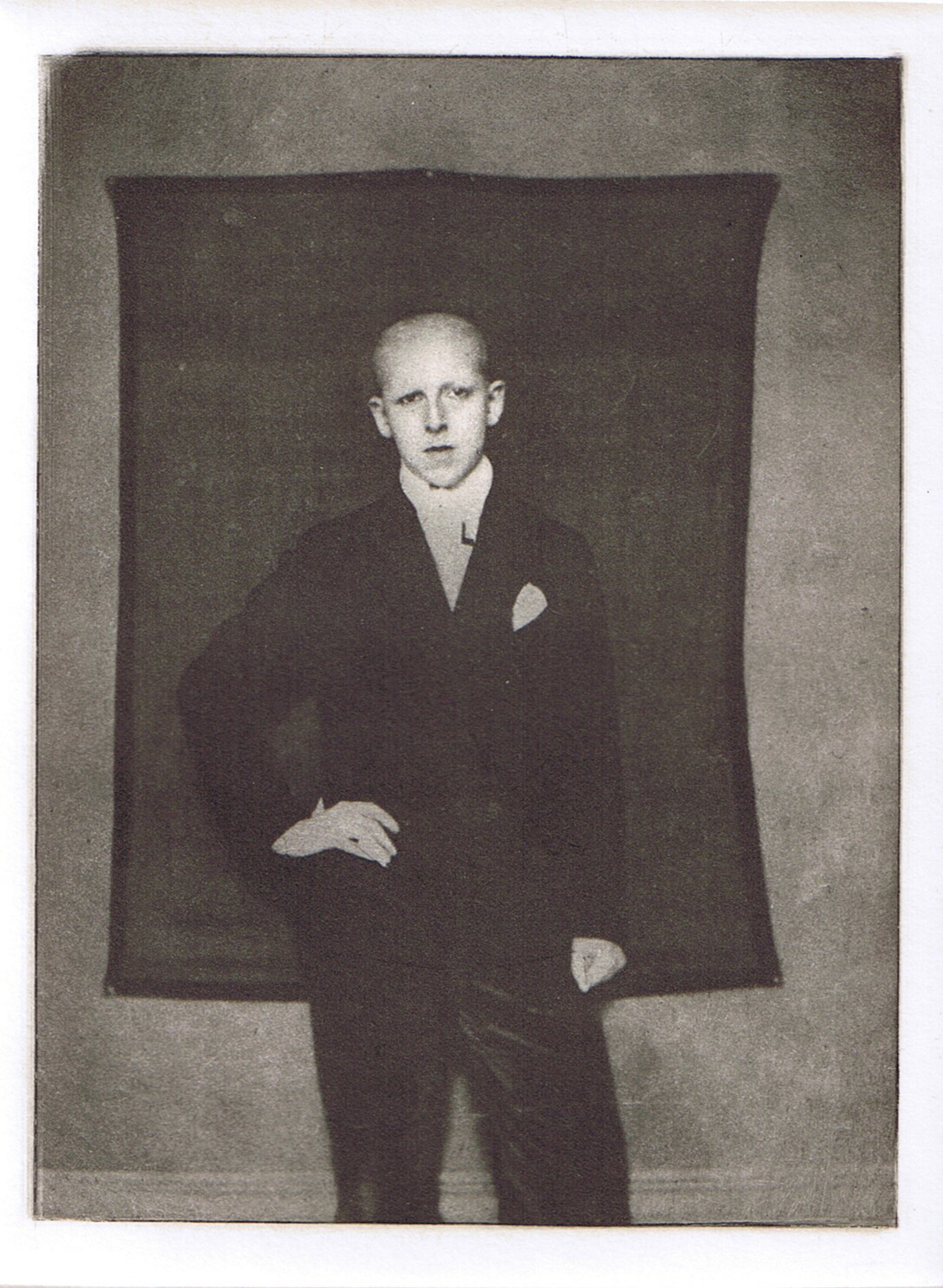
Claude Cahun, born Lucie Schowb (1894-1954) was an artist and photograph developing a queer approach. Friend with the Surrealists, she worked on numerous photomontages but was less known for her photographic self-portraits in which she developed an androgynous representation of the female body. 
Without a doubt, it is her self-portraits that have aroused the greatest interest among theoreticians of contemporary culture. Here the artist uses her own image to expose, one by one, the clichés of feminine and masculine identity. Claude Cahun (née Lucy Renée Mathilde Schwob) reinvented herself through photography (just as she did in her writing), posing for the lens with an acute sense of “performance,” whether dressed as a woman or as a man, with her hair short, long or shaven (which was extremely incongruous for women at this time). However, to speak of identity is also to speak, indirectly, of the body, and by the same token of the self-image that one projects and that becomes social as soon as it is shared. Unlike other artists – mainly men – who made portraits but never or very rarely exposed their own person to the lens (Man Ray, Hans Bellmer, André Kertész), Claude Cahun was at once the object and the subject of her artistic experiments. This is borne out by the care with which she chose her poses and expressions, the backgrounds she used (fabric, bedspreads, sheets, hangings), and her use of specific props (masks, capes, overgarments, glass balls, etc.) – even if the real focus of the image was still the face.
- in press pack of the exhibition  at the Jeu de Paume from 24  may to 25 september 2011.

En 1992, François Leperlier published a bibliographic essay named  "Distance and metamorphosis". Three heliographic and aquatinted engravings  go with  the 66 first copies of this first edition, and one can see the  enigmatic and poetic nature of the artist : 


Currently, the librairie Loliée offers : 
  • Leperlier (François). Claude Cahun. L'Ecart et la métomorphose. Essai. Paris, Jean-Michel Place, 1992, in-8, illustrated covers. First edition. Limited to 2000 copies, one of the 66 first with 3 heliographic and aquatinted engravings.

May 05, 2011

Vrille : Taking a surrealistic pulse after the Second World War

Surrealist magazine published at the end of World War II, Vrille is a only one number revue. As explained in the introduction "alibi", the purpose of this magazine, directed by Evrard de Rouvre (heir to a vast fortune built on the sugar industry, who became a film producer before being assassinated in 1979 by his valet), is to collect "texts, illustrations little-known from a public asleep by the grayish fog of a propaganda that clung to dimonstrate the emptiness of efforts of humans who, during the inter-two wars, tried to open art to wonderful horizons. But Vrille was especially attached to revive a tradition, over these four years of darkness, presenting texts as young witnesses of an overwhelming era, witnesses of the hope of whom who found in Surrealism the strength to contribute to the reconstruction of modern thought. "

One can find in the magazine, illustrated with many reproductions, the work of great figures of Surrealism including Oscar Dominguez who signed the illustrated cover. Among the texts, there is beautiful collection of Robert Desnos "Notes Calixto," in which the author discusses the literary influences in Surrealism, the importance of Mallarmé's work, gives us his thoughts on poetry :
Poetry gets landed with words and can not do otherwise. It also adopts sometimes (not poetry, fake poets of course) a cowardly attitude before the biggest questions : happiness, men future, the nature of being. Poetry is more often conciliation than resolution. Is it not possible to renew the links between poetry and science? 

Currently, the librairie offers  : 
  • [REVUE]. Vrille. La Peinture et la littérature libres. Mantes, s.é., 1945, in-4, illustrated cover by O. Dominguez.  First edition. Texts de G. Bataille, E. de Rouvre, R. Desnos, G. Hugnet, H. Michaux etc. Illustrations by O. Dominguez,  M. Ernst, P. Picasso, Dali...

March 24, 2011

Le surréalisme, même : a major surrealist magazine of the postwar period


Published by the book-dealer Jean-Jacques Pauvert from October 1956 to spring 1959, Le Surréalisme, même constitutes a major surrealist magazine of the postwar period. André Breton seeks to give new impulsion to Surrealism and brings together different generations of surrealists or works with artists close to the movement (and Pierre Molinier, known for his photo-montage, makes the cover of the second issue).
The title of the revue, stopped after 5 issues - which makes  its rarity, is an allusion to the painting project of Marcel Duchamp, "La Mariée mise à nu par ses célibataires, même" (read a project description, in french, here). Note that the first issue, contains an extra: Les Détraqués by P.-L. Palau, a piece that fascinated Breton and to which he devotes several pages in Nadja (one can understand why the story seduced the founder of the Surrealism : a morphine addict teacher, prone to  homicidal madness crisis and sexual  perversion, runs wild in a college, among  girls decents in every ways.)


Actuellement, la librairie Loliée propose :

  • [REVUE]. Le Surréalisme, même. n° 1 (octobre 1956) à n° 5 (Printemps 1959). Paris, Librairie Jean-Jacques Pauvert,  5 volumes in-8 carré, brochés, couvertures illustrées. Collection complète de cette revue surréaliste majeure de l'après-guerre dirigée par André Breton.

December 01, 2010

The skills of Valentine Penrose


The phantasmagoria of Valentine Penrose 's images and poems, by the clever and marvel of  her writing, by the naive objectivity of her collages, make me gain confidence in myself and in the virtues of truth given.
In these words Paul Eluard evokes the work of Valentine Penrose (1898-1978) in Dons des Féminines, from which he wrote the preface. The poetess and surrealist collagist had multiple lives : in England with her husband, the photographer Roland Penrose, in Spain, where she mes a guru, in India where she went to live in an ashram with the painter Alice Rahon Paalen,  in Algeria where she  wassent in 1944 after enlisting as 3rd class soldier. Woman of character with a beauty appreciated by the surrealists, Valentine Penrose  celebrates womanish, sometimes flirting with racy eroticism.

  
Currently, the librairie Loliée offers : 
  • Penrose (Valentine). Dons des féminines. Préface de Paul Éluard. Paris, Les Pas Perdus, 1951, in-4, covers. Édition illustrated with 25 full page collages by Valentine Penrose. Limited to 400 numbered copies. Preface by Paul Éluard.

November 03, 2010

Flagrant délit : when A. Breton denounces La Chasse Spirituelle

In 1949, in a pamphlet entitled Flagrant Délit, André Breton denounced and came back on one of the funniest literary fakes of the twentieth century. On 19th May of the same year, the editor Le Mercure de France, under the leadership of Maurice Saillet and Pascal Pia, published a lost manuscript of Arthur Rimbaud : La Chasse Spirituelle. In the preface of the book, Pascal Pia put forward the parallels between the previous work of the young poet and these pages. Breton was the first to rose up and demonstrated that those writings were misleading and parody :
Even if the abuse of trust lasts only a second, there is an injury to the innocence - innocence without which there can be no emotional apprehension of a art work and that leaves us with the suspicion of a trap.
Le Mercure de France withdrew the book from sale and gave the profits to the Rimbaud Museum. The perpetrators of this fraud, the actors Nicolas Bataille and akakia Viala, finally came forward and explained their motivation : the theatrical show they had created in 1948, an adaptation of Une Saison En Enfer, was demolished by the critics and they wanted to trap their detractors.
We now know that the manuscript La Chasse Spirituelle probably never existed. This title was made up by Paul Verlaine to designate a compromising correspondence with Rimbaud, discovered by his wife Mathilde, and that he wished not to be used in a divorce proceedings.

Currently, the Librairie Loliée offers :
  • [Rimbaud (Arthur)]. La Chasse spirituelle. Introduction de Pascal Pia. Paris, Mercure de France, 1949, in-8 carré, cover. Firs Edition. Copy on velum paper.
  • Breton (André). Flagrant Délit. Rimbaud devant la conjuration de l’imposture et du trucage. Paris, Thésée, 1949, illustrated cover. Firs edition. One of the 100 first copies on Holland paper, signed by André Breton . Copy dedicated to Edmond Bomsel.

April 28, 2010

Surrealist tracts from the Aragon case

In 1927, following Paul Eluard and with André Breton, his two friends from Surrealism, Louis Aragon joined the Communist Party. In 1930, he went to the USSR, to represent the Surrealists Congress of Revolutionary Writers in Kharkov. Vladimir Mayakovsky, critic of the new regime, has just committed suicide. The Communists of strict obedience suspect the surrealists to drift to Trotskyism and anarchism. Aragon took sides and, on his return to France, published a poem, Front Rouge, which broke with surrealism aesthetic. His tone is provocative [Pliez les réverbères comme des fétus de pailles / Faites valser les kiosques les bancs les fontaines Wallace / Descendez les flics / Camarades / descendez les flics / Plus loin plus loin vers l'ouest où dorment / les enfants riches et les putains de première classe/ Dépasse la Madeleine Prolétariat/ Que ta fureur balaye l'Élysée] and, in 1931, Aragon is charged for inciting to murder.
If Breton defends him by publishing L'Affaire Aragon, he also denounced in Misère de la poésie how Front Rouge is "poetically regressive". The break -up between Surrealists and Aragon is consumed.

Currently, the librairie Loliée offers :
  • Certificat. Paris, 1932. 1 leaf in-4, recto. Printed in black on green paper. Famous tract against Aragon signed by Paul Eluard who ends with a Lautreamont quote : « Toute l’eau de la mer ne suffirait pas à laver une tache de sang intellectuelle. »
  • L’Affaire Aragon. Paris, january 1932. 2 leaves in-4, the second removable, printed in red on velum white paper. Tract asking for solidarity with Aragon, signed by 12 members of the movement.
  • Paillasse ! (Fin de « l’affaire Aragon »). Paris, Éditions Surréalistes, March 1932. stapled booklet, in-8. Pamphlet against Aragon by Char, Crevel, Dali, Eluard, Ernst, Péret, Tanguy et Tzara.

March 03, 2010

Dorothea Tanning : a surrealism woman

Born in 1910, Dorothea Tanning left his family in 1930 to follow the course of the Academy of Arts in Chicago. She then moved to New York and lived from advertising works. She is strongly impressed by the 1936 exhibition "Fantastic Art, Dada, Surrealism" and, in 1942, she joined the New York surrealism's group led by André Breton in exile. She met Max Ernst, who is then married to Peggy Guggenheim. She became, in 1946, the fourth wife of the German artist, during a double ceremony which also united Man Ray to the dancer Juliet Browner. In 1953, Ernst and Tanning settled in France. Two years after the death of Max Ernst in 1976, Dorothea Tanning returned in New York.
Her work is anchored in Surrealism but focuses more specifically, in the 50s, on the figure of the woman, of the muse. In 1974 a retrospective is done in Paris, at the Center Pompidou, by Pontus Hulten.

At nearly 100 years, Dorothea Tanning is one of the last living members of the surrealist movement.
(source: dorotheatanning.org)

Currently, the librairie Loliée offers :
  • Tanning (Dorothea) - Sartoris (Ramon). Three Plays. S.l [Washington], The Black Sun Press, 1944, in-4, hardcover. First edition with 3 original drawings by Dorothea Tanning. This copy is dedicated by Tanning to Paul Eluard.

December 11, 2009

Zürn / Bellmer : Dark Spring


Compagnion of Hans Bellmer, Unica Zürn, born in Berlin in 1916, had with the surrealist artist met in 1959, a stormy relationship marked with various interments in psychiatric clinics. It's from Bellmer's flat that Unica jumped out of the window in 1970. Fragile, Unica Zürn described her childhood as wonderful. This period was nevertheless marked by the divorce of her parents, and the loss of the family home, where his father, writer, used to collect objects brought back from his travels. "Dark Spring is the story of her childhood's impressions pushed up to their tragic consequences. Between a father beloved but distant and a hated mother, the little girl will learn about the adult world, and will discover an horrifying and fascinating sexuality, a crazy love which will lead her to suicide "(biography from Belfond publisher -1971).


Currently, the librairie Loliée offers :
  • [Bellmer (Hans)] - Zürn (Unica). Sombre Printemps. Traduit de l’allemand par Ruth Henry et Robert Valançay. Burin original de Hans Bellmer. Paris, Pierre Belfond, collection des « Cahiers du regard », 1970, in-folio, in leaves, publisher's case. First french edition with, on frontispiece, an original engraving by Bellmer, numbered and signed. Limited 170 copies on Arches paper, this one compelted with a suite of the engraving on Japan paer, numbered and signed.
  • [Bellmer (Hans)] - Zürn (Unica). Sombre Printemps. Traduit de l’allemand par Ruth Henry et Robert Valançay. Paris, Belfont, « Cahiers du Regard », 1971, thin in-8. First french edition with, on frontispiece, a reproduction of Bellmer's engraving.

November 05, 2009

Poetical pluralism of Jorge Camacho


Cuban painter, born in 1934, Jorge Camacho studied law till 1952 when he decided to devote himself to painting. He travelled to Mexico in the 50s with the painter Jose Luis Cuevas and is interested in Mayan culture. In 1959, he moved to Paris where he met André Breton. He joined the Surrealist group and in 1965, participated at the XI International Exhibition of Surrealism. He became a close friend of Henri Michaux and Joyce Mansour. In 1967, he exhibited at the Salon de Mai in Havana organized by Wifredo Lam, also Cuban. From 1968 he became interested in studying the science of alchemy, the Cabala, shamanism. Curious about everything, collector of "primitive art" Jorge Camacho fuels his art by drawing from various cultures and artistic creations: jazz, Andalusian music, French and Haitian poetry, photography. He lives and works between Paris and Andalusia since 1975.
(sources: wikipedia, maison de l'amérique latine)


Currently, the librairie Loliée offers :
  • [Camacho (Jorge)] - Bedouin (Jean-Louis). Libre Espace. Paris, Seghers, 1967, in-8, in leaves. First Edition. One of the 66 first copies on Holland paper with an orginal engraving numbered and signed by Camacho.
  • [Camacho (Jorge)] - Mansour (Joyce). Faire signe au Machiniste. Couverture et Illustrations de Jorge Camacho. Paris, Le Soleil Noir, 1977, in-8. First edition illustrated in black by Camacho. Copy on vellum paper.
  • [Camacho (Jorge)] - Canseliet (Eugène). L’Hermétisme dans la vie de Swift et dans ses voyages. Illustré par Jorge Camacho. Montpellier, Fata Morgana, 1983, in-12. First edition. Copy on "verger teinté" paper.

October 16, 2009

René Char : science, a blind lighthouse

In May 1968, apart from the social events that shake France, René Char has a heart attack, first in a long series of cardiovascular accidents. He mentions that "experience" in the introductory text of the Le Chien de coeur, published a year after : "I thought death was coming, but death where, overwhelmed by an unprecedented understanding, I would still need to make a move before falling asleep, before being spread out to the universe forever." This collection, illustrated with an original lithograph by Joan Miro for the first 95 copies, expose six poems, including "Les Apparitions dédaignées" (despised Apparitions), text denouncing the absurd distortions of modern society. The poet discredits the usefulness of science which consolidate a little more the divorce between man and nature :

"Les civilisations sont des graisses.
L'Histoire échoue, Dieu faute de Dieu
n'enjambe plus nos murs soupçonneux,
l'homme feule à l'oreille de l'homme,
le Temps se fourvoie, la fission est
en cours. Quoi encore?

La science ne peut fournir à l'homme
dévasté qu'un phare aveugle, une arme
de détresse, des outils sans légende. Au
plus dément : le sifflet des manœuvres."
Qute from "Les Apparitions dédaignées" in Le Chien de coeur.

Currently, the librairie Loliée offers :
  • Char (René). Le Chien de cœur. Paris, G.L.M., 1969, in-8. First edition. One of the first 95 copies on Arches paper with an original color lithograph signed by Joan Miro. (Only those copies have the lithograph).

September 04, 2009

Georges Hugnet, a released surrealist

Georges Hugnet (1906-1974) grew up in Buenos Aires where his father opened a branch of the family firm specialized in wood furniture. He moved to Paris in 1913. Man with many talents, Hugnet composed poems, wrote articles, made photo-montages, was also a publisher. In 1920, he became friend with Marcel Jouhandeau, his neighbour, who introduced him to Max Jacob. With financial support from his father, he founded the Editions de la Montagne, whose goal was to publish his own work and those of friends as Tristan Tzara, Gertrude Stein. He joined the Surrealist group in 1932 through Tzara who introduced him to André Breton. Hugnet left the movement in 1939. Breton reproached Hugnet for maintaining friendship with Paul Eluard, who distance himself with the leader of Surrealism because of their political disagreement during the Spanish Civil War. However, in occupied France, Georges Hugnet joined La Main à la plume, a group that maintained the surrealist publications while Breton went into exile in 1941. While officially out of the movement, Georges Hugnet never ceased to be a part of it.

Currently, the librairie Loliée offers :
  • Le Droit de Varech. Illustrés de 5 lithographies par Eugène Berman. Précédé par le Muet ou les Secrets de la vie. Paris, Editions de la Montagne, 1930, in-4, bound in full green calf by A. Lobstein. First edition. Limited to 502 copies. One of the first 10 copies on Japan paper, signed by the author and the illustrator, and with 5 original full-page lithographs by Eugène Berman. (only the 100 first copies include those lithographs).
  • Le Droit de Varech. Illustrés de 5 lithographies par Eugène Berman. Précédé par le Muet ou les Secrets de la vie. Paris, Éditions de la Montagne, 1930, in-4. First edition. Limited to 502 copies. One of the first 25 copies on Holland paper, signed by the author and the illustrator, and with 5 original full-page lithographs by Eugène Berman. (only the 100 first copies include those lithographs).
  • La Belle en dormant. Paris, Editions des Cahiers Libres, 1933, in-12. First edition. One of the 500 copies on vellum paper.
  • L'Apocalypse. Paris, G.L.M., collection "Habitude de la Poésie", 1937, in-16. First edition. One of the few copies on two-coloured glossy paper.
  • La Femme facile. Illustrations de Christine Boumeester et Henri Goetz. Paris, Jeanne Bucher, 1942, in-12 oblong, in leaves, illustrated cover. First edition with a frontispiece and 14 lithographs by Christine Boumeester and Henri Goetz and with the text reproduced in facsimile. Limited to 115 copies. One of the 5 copies reserved to the author, on "mûrier de Tonkin" paper, enhanced with a plate lithograph of Ch. Boumeester.
  • La Nappe du Catalan. 64 poèmes et 16 lithographies en couleurs. Paris, s.n.é., 1952, in-4, illustrated cover, folder and case. First edition of poems by Hugnet and Cocteau composed simultaneously on restaurant tablecloths. Illustrated with 16 lithographs by Cocteau, coloured by Hugnet. Limited to 113 copies, this one on Rives paper enhanced with an ink and wash drawing, and a dedication by Georges Hugnet to Valentine Hugo.
  • 1961. Illustré de quatre photo-montages. Paris, chez l’Auteur, 1961, in-8, in leaves, illustrated cover. First edition with 4 photo-montages by Georges Hugnet. Copie on vellum paper.

May 27, 2009

Paul Eluard and Valentine Hugo : men and animals


SPIDER
Discovered in an egg,
the spider won't go in again.


HEN
Let the hen pond:
hen with its ripe fruits,
Hen with our gain.


quotes from Les Animaux et leurs hommes. Les Hommes et leurs animaux [
Animals and their men. Men and their animals] by Paul Eluard, illustrated by Valentine Hugo.

Actuellement, la librairie loliée propose :
  • Hugo (Valentine) - Eluard (Paul). Les Animaux et leurs hommes. Les Hommes et leurs animaux. Paris, Gallimard, s.d.[1938], in-12. New edition with 22 illustrations in black by Valentine Hugo. Limited to 1300 copies. This one with a hand-writing dedication from Valentine Hugo and Paul Eluard to the poet Philippe Dumaine.

April 02, 2009

Under the eye of BIEF

The return to power in 1958 by General de Gaulle, following the Algerian crisis, is seen as a fascist coup d'état by the surrealist movement. Under the guidance of André Breton, his faithful collaborator, Gérard Legrand mobilizes the new guard - including Jose Pierre, Jean Robert Benayoun and Schuster, to create the journal BIEF, a surreal junction destined to express the positions of the movement. "In the locks of Surrealism, that is to be understood once and for all that water that goes down and up stays the same, yet always renews itself: BIEF attempts to identify each month, a reflection of that water." (issue No. 1 - November 15, 1958).
On can discover, over the pages, some political articles, as the text by José Pierre published in the issue No. 5 - March 15, 1959 and entitled " A People falling apart." The author is concerned about the "passive disgust" of the youth, a part of which just comes back from Algeria and protests: "We must stop to continually blow up out of proportion Joan of Arc, campaigns of Louis XIV or Napoleon! That the few persons who are not rotten provide youth a true intellectual and revolutionary education. All is not yet lost. "
BIEF
also offers literary and artistic criticism as well as a section maintained by Joyce Mansour who uses a nicely and provocative tone. Note that the cover of issue No. 9, published on December, 1th 1959, is devoted to Benjamin Péret, deceased a few months earlier, and who contributed to the journal.

Currently, the librairie Loliée offers :
  • [REVUE] BIEF. Jonction surréaliste. N°1 à N°12, november 1958 - april 1960. Paris, Le Terrain Vague, 11 stapled booklets, in-4, case. Complete collection, in deluxe edition, of this surrealist journal with illustrations by Benjamin Péret, Hans Bellmer, Jean-Jacques Lebel, Robert Lagarde, Arshile Gorky, Toyen, Mimi Parent, Wolfgang Paalen, etc. Texts by Legrand, Breton, Arp, Mansour, Legrand, Schuster, Péret, etc.

February 19, 2009

The narrative poetry of Robert Desnos

Robert Desnos joins André Breton in the early Surrealism and became one of the key members of the movement. He tells his dreams, writes and draws in a state of trance. He uses his technique to express the spontaneity of his inspiration. He feels quickly shut by the doctrine of Breton and left the group in 1930. His style became less eccentric. Desnos develops then a poetry closer to the harsh reality marked by the Second World War. From this period dates Etat de veille (literally "standby state"), which reflects this form of narrative poetry specific to Desnos.

"Poser sa tête sur on oreiller
Et sur cet oreiller dormir
et dormant rêver
A des choses curieuses ou d'avenir,

Rêvant croire à ce qu'on rêve
Et rêvant garder la notion
De la vie qui passe sans trêve
Du soir à l'aube sans rémission.

Ceci est presque normal,
ceci est presque délicieux
Mais je plains ceux,
Qui dorment vite et mal,

Et, mal éveillés, rêvent en marchant.

Ainsi j'ai marché autrefois,
J'ai marché, agi en rêvant,
Prenant les rues pour les allées d'un bois.

Une place pour les rêves
Mais les rêves à leur place."
Rêves - in Etat de veille - 1944

Currently, the librairie Loliée offers first editions of Robert Desnos :
  • Deuil pour deuil. Paris, Editions du Sagittaire, les Cahiers Nouveaux, 1924, in-16. Copy on Rives paper.
  • Corps et Biens. Paris, N.R.F., 1930, in-8. One of the 109 first copies on Lafuma paper.
  • Etat de Veille. 10 gravures au burin par Gaston-Louis Rond. Paris, Pour mes Amis, 1943, in-4, en feuilles, chemise. 10 full page original engravings by Gaston-Louis Rond. One of the 20 copies on Arches paper including one original drawing, 1 suite of the engravings on China paper and 5 refused engravings.
  • Mines de rien. Paris, Broder, 1957, in-12, in leaves, publisher's case. 4 full page originals engravings in color by André Masson. Limited to 130 copies on Rives signed by the illustrator.
  • Mines de rien. Paris, Broder, 1957, in-12, beautiful binding by Semet et Plumelle. 4 full page originals engravings in color by André Masson. Limited to 130 copies on Rives signed by the illustrator. Un des 10 copies not mentionned in the limited edition, including a suite in black of the engravings, each engraving justified an dsigned by Masson.
February 05, 2009

Max Bucaille's daydreamings


At first mathematician, Max Bucaille (1906-1992) joined the surrealist group in 1947. Collagist and poet often overshadowed by Max Ernst, he built a major work. In The Dream Scanner, one of his better knowns books published by G.L.M. in 1950, the poet Jean Laude, writer of the preface, presents the work of the artist:
"Max Bucaille, since it's him we speak about, takes a pair of scissors and glue. He takes old illustrated books and, for our pleasure, daydreams. [...] Who will watch, who will dreams of these images, will maybe better supported in the real world those objects that are composed here. "


Currently, the librairie Loliée offers :
  • Bucaille (Max). Le Scaphandrier des Rêves. Preface by J. Laude. Paris, GLM, 1950, in-12. First edition with 13 collages, with the cover, by the artist. Limited to 500 copies on vellum paper.
  • Bucaille (Max). Entre le Sommeil et le noir. Paris, Le Nyctalope, 1982, thin in-12, brochée. First edition with 7 collages, by the artist. Limited to 333 copies on Arches paper.

January 07, 2009

Primitive Art according to Wifredo Lam


Cuban painter, born of a Chinese father and a mulatto mother, Wifredo Lam went to Fine Arts School in Havana and then moved to Barcelona to continue his studies. Running away from the Spanish Civil War, he sought refuge in Paris in 1937. Picasso took him under his wing and had him meet with the Surrealists. Lam joined the movement and André Breton offered him to illustrate his poetic collection Fata Morgana. In 1940, Lam went to Marseille where he obtained a visa to leave for Cuba. He took the plane with a few friends, including Breton and Ernst, and eventually landed in his native land. In 1942, the Matisse Gallery in New York organized the first exhibition of his works. Where Picasso and his contemporaries promote African Art as a new approach to European pictorial tradition, Wifredo Lam, in the other way, influenced by great masters - including Bosch and Goya, uses his mixed race heritage to create a primitive word more universal.


Currently, the librairie Loliée offers :
  • Lam (Wifredo) - Jouffroy (Alain). L’Antichambre de la nature. Eaux-fortes originales de Wifredo Lam. Paris, Collection Paroles Peintes, Odette Lazar-Vernet, 1966, folio, loose as issued in the original wrappers. First edition with 9 original etchings by Wifredo Lam. Limited to 85 copies. One of the 50 copies on B.F.K Rives paper, signed by the author and the artist.

October 22, 2008

Fortune's surprises


"During the "initiation" of a series of lithographs in color, my friend Pierre Chave, experienced lithographer, discovered by chance, the brightness due to the fortuitous compositions.

The process is simple: instead of throwing in the garbage the tests obtained by the successive and random overlays , make the effort - or take delight in - and look closely (or afar). Let freely go the games of your imagination. Rejoice with the suddenness of your mental and sensual associations, of harmonies and dissonances of color that fortune chooses and lays by for you.

Show results to your friends - and even your enemies. Observe their reactions. Continue tomorrow. You will not be disappointed. "

Max Ernst - preface to the catalog of the gallery Alphonse Chave

Currently, the Librairie Loliée offers :
  • [Ernst (Max)]. Livres et publications surréalistes. Paris, José Corti, 1932, plaquette in-12. Firts edition of this catalogue of José Corti Bookshop. On the cover, an original drawing by Max Ernst.
  • Ernst (Max) - Carrington (Leonora). La Dame ovale. Avec 7 collages par Marx Ernst. Paris, G.L.M., 1939, in-12. First Edition with 7 full-page illustrations by Max Ernst. Copy on vellum paper.
  • Ernst (Max) - Peret (Benjamin). La Brebis galante. Paris, Editions Premières, 1949, in-4, illustrated cover. First edition with 3 original engravings in color by Max Ernst. Limited edition to 321 copies, this one on Arches vellum paper.
  • Ernst (Max) – Breton (André) - Peret (Benjamin). Almanach Surréaliste du Demi-Siècle. La Nef, numéro spécial, 63/64, Paris Sagittaire, Mars-Avril, 1950, in-8, illustrated cover. One of the 65 copies on Lafuma vellum paper, with 2 original lithographs in color, full-page, signed by Max Ernst and by André Breton.
  • [Ernst (Benjamin)] – Peret (Benjamin). Mort aux vaches et au champ d’honneur. S.l. (Paris), Arcanes, 1954, grand in-4. First edition. One of the 54 first copies on Arches vellum paper, with as a frontispiece, an original engraving in color signed by Max Ernst. Copie of the author.
  • Ernst (Max). Ecritures. Avec cent vingt illustrations extraites de l’œuvre de l’auteur. Paris, N.R.F Point du Jour, 1970, fort in-8, illustrated cover. First collective edition.
  • Ernst (Max). Catalogue de la Galerie Alphonse Chave. Vence, du 13 février au 12 mars 1971, petit in-4, en feuilles, illustrated cover. Preface by Max Ernst. Original lithograph in color on the cover and 12 illustrations in color. Limited edition to 1000 copies. One of the first 90 copies with an orignal and signed lithograph, in color, on Japan paper, by Max Ernst. Enhanced with an autograph of the artist.
  • Ernst (Max). Lieux communs. Décervelages. S.l. [Milan], A. Iolas, 1971, brochure in-8. This booklet was print for the Max Ernst's exhibition « Lieux communs » at the gallery Alexandre Iolas in Paris. Limited edition to 1000 copies.