Showing posts with label first editions of 20th. Show all posts

December 21, 2011

Dubliners by James Joyce

Dubliners, which is an excellent introduction to the work of James Joyce, is, by itself, one of the most important books of imaginative literature in English published since 1900.
Thus, Valery Larbaud concluded the preface that opens the original French edition of Dubliners, collection of fifteen short-stories published in 1914 (for the original English edition). James Joyce sets up portraits of people who have in common to live in the Irish capital, where the author is also born. We are far from folklore. As a clinician, James Joyce describes the lives of these characters, deals with various themes (family, alcohol, politics, religion). The most famous short-story is for sure  "The Dead" immortalized in 1987 by John Huston's film. We are in 1904, January 6. As every year, two sisters, Kate and Julia Morkan, and their niece Mary, receive relatives and friends to celebrate Epiphany. Among them is Gabriel Conroy, the nephew of the Morkan sisters, and his wife Gretta. From Gaelic poems reading to songs, dances and between dishes that follow one another, the guests maintain ploite conversations and begin to discuss the loved and dead ones, both famous and unknown.


Currently, the librairie Loliée offers : 
  • JOYCE (James). Gens de Dublin. Traduit de l'anglais par Yva Fernandez, Hélène du Pasquier, Jacques-Paul Reynaud. Préface de Valéry Larbaud. Paris, Plon, collection d'auteurs étrangers, 1926, in-12, broché, case. First French edition.

December 14, 2011

Jacques Prévert, the antifascist

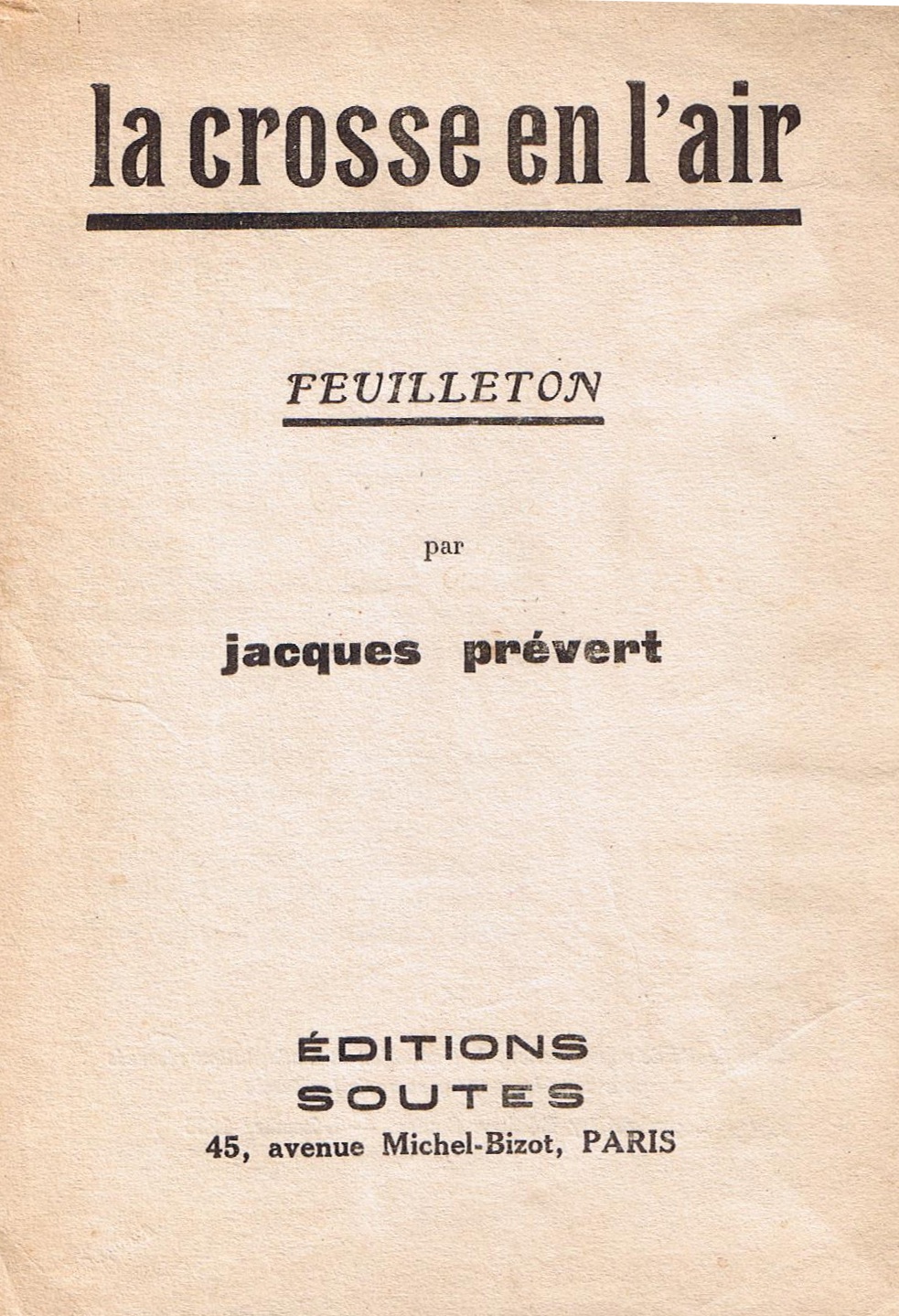
La Crosse en l'air, indictment of the collusion of Church and fascist ideology, is part of the famous collection Paroles (1946). But the original edition of this "feuilleton" is from 1936, published by les Editions Soutes. This was the period of the Popular Front, the Spanish Civil War. Jacques Prévert, since 1932, is part of the Groupe Octobre, a theater company, for which he wrote plays and spoken choirs. If he is not a member of the Communist Party, he joined the revolutionary struggle. La Crosse en l'air, whom title is quote from the Internationale, provides a series of virulent humorous portraits, figures from Paris and Rome, during a the journey of a funny night watchman who goes tell the Pope what he trully thinks.
Below, this famous text told by  Serge Reggiani, who was also a member of the Groupe Octobre.


Currently, the librairie Loliée offers :
  • PREVERT (Jacques). La Crosse en l’air. Feuilleton. Paris, Éditions Soutes, 1936, booklet in-12, Rare first edition.

October 21, 2011

Catherine Pozzi : the purity of classical poetry

It is in 1987, with the publication of her journal, that the work and the character of Catherine Pozzi (1882-1934) is rediscovered. Born into an aristocratic and wealthy family, the young woman, bright and well-educated, met at home José-Maria de Heredia, Paul Bourget. After studying with tutors, she completed her education spending one year at Oxford. At 25, she married the succesful playwright Edouard Bourdet, and of that consensual union, was born a son, Claude. A year after ther birth, the young mother experiencing the first symptoms of tuberculosis. Catherine Pozzi resumed her studies and got the baccalaureate at the age of 37. In 1920, she began a relationship with Paul Valéry that lasted 8 years. The important correspondence between the two lovers, published by Gallimard in 2006, shows the the tumultuous of the relation and also the influence that the author had on Catherine Pozzi's work. The poet died in Paris in 1934, undermined by disease and drugs.

Of her publications, essentially posthumous, we note, in addition to her journal, her correspondences with Jean Paulhan and Rainer Maria Rilke. If her work is the reflect of a time and of her skills, her poetry, although dazzling, is marked with a classicism and purity worthy of the greatests. The collection Poèmes, published in 1935, gives a reading of six pieces ; the last "Nyx" ("night" in Greek) was composed at one go, a month before the death of the poet :
O you, my nights, O long-awaited black-
ness, O proud country, O obstinate sec-
rets, O long looks, O thundering clouds
O flight beyond skies which are closed

O great desire, O scattered surprise
O beautiful journey of th’ enchanted sprite
O worst evil, O grace that flies
O open door where we enter night

I don’t know why I die today
Before th’ eternal rest above.
I don’t know for whom I’m prey
 I don’t know for whom I’m love.
Currently, the librairie Loliée offers :
  • POZZI (Catherine). Poèmes. Paris, Mesures, s.d. [1935], booklet in-8. First Edition. Limited to 410 copies, one of the first 10 on Holland paper.

September 14, 2011

Alberto Moravia : purveyor of tales

Alberto Moravia (1907-1990) was an iconic figure of modern literature that marked the 50s and 60s. Suffering from tuberculosis, he never finished his studies. Perhaps that explains his thirst for knowledge. He has apprehended the mains currents  of his time (surrealism, existentialism, psychoanalysis) and rejuvenated literature, sometimes making some scandal, to address three main themes: fascism, bourgeoisie and  male/female relationships. His work finds a particular resonance with filmmakers who relay the richness of his view on society: Two Women (1960) De Sica, Contempt (1963) Godard or The Conformist (1970) Bertolucci.


Published in Italy in 1941, The Fancy Dress Party (La Mascherata) is a farce in which Moravia, mixing comic opera love and dictatorship, criticizes Mussolini fascism  (see a summary below published by Gallimard) :

 General Tereso hated the Duchess Gorina, in which he saw embodied all the pride, ignorance, corruption and vanity of the old nobility. Gorina invited him  to a fancy party and he made his usual answer: to his great regret, the affairs of the state forbade him to indulge in this kind of distractions.
The Duchess, impassive and haughty, dropped casually  that this refusal would distress the Marquise Fausta Sanchez, who hoped to meet him at the festival. Tereso, who  chased  for months and in vain Fausta, felt at that name his heart, despite his age and his experience, pumped with juveniles beatings  in his chest.
"I understand," thought Tereso, "the price of Fausta is my first participation in the party".
More the plot advances and  more the quadrille bteween the protagonists slides to a dance of death. Satire is blatant and the novel was censored. It was not until 1950 that the book was published in France.

Published later (1967 for Italy and 1968 for France), Command, and I Will Obey You (Una cosa e una cosa) is a collection of short stories in which Moravoia express is taste for caricature, sometimes to surrealism.  In "The Law of Laws", the protagonist, Ettore, has the sensation that a bomb exploded in his head. If there is no external changes, he can no longer do anything unless he finds a law or rule, or a standard indicating how he should behave.

In one of his last interviews, given to the Magazine Littéraire in November 1990, Moravia recall with simplicity: "My goal is to write a fable and, pursuing this story, I come into contact with the culture of the time."

Currently, the librairie Loliée offers : 
  • Moravia (Alberto). Le Quadrille des masques (La Mascherata). Traduit de l’italien par Armand Pierhal et Viviana Paques. Roman.  Paris, Gallimard "Du monde entier", 1950, in-12. First french edition. One of the 250 copies on Lafuma vellum, only deluxe paper.
  • Moravia (Alberto). Une Chose est une chose. Nouvelles. Traduit de l’italien par Simone de Vergennes. Paris, Flammarion "Lettres Etrangères", 1968, in-8. First french edition. One of the 30 copies on Alfa vellum, only deluxe paper.

July 07, 2011

Jules Supervielle : a quiet strenght

Jules Supervielle (1884-1960), raised between France and Uruguay, is a man between the two worlds, both in his life and in his work. Contemporary of the Surrealists, he does not adhere to the movement, rejecting the too much emphasis given to unconscious writing. His poetry iwants to be humanist, in a simple and transparent way, and mixes everiday life with a marvellous aprehension of scenery.  Childhood and death are two recurring themes of his work (he lost his parents in a tragic accident while he was still a baby). His early writings are influenced by a Larbaud or Laforgue. He develops a quiet lyricism that addresses the great mysteries of the universe with humility. Poetry, stories, theater : his work breaks with conventional models while maintaining a commitment to accuracy and delicacy in his use of language.

Currently, the librairie Loliée offers :
  • Les poèmes de l'humour triste. Ornés de dessins inédits par Messieurs André Favory, André Lhote et Dunoyer de Segonzac. Paris, la Belle Edition, 1919, tall in-8. First edition with original illustrations. Limited to 315, this one on Arches paper. 
  • Le Survivant. Paris, Gallimard, 1928, in-4 tellière. First edition. One of the 110 copies in-quatro tellière. 
  • Boire à la source. Confidences de la mémoire et du paysage. Paris, Editions Corréâ, 1933, in-12. First edition.
  • L'Arche de Noé. Paris, Gallimard, 1938. Press copy with a dedication to the French writer Yves Gandon.
  • Oublieuse Mémoire. Paris, Gallimard, collection "Métamorphoses", 1949, in-12, broché. Edition originale. Mention fictive d'édition. 
  • Shéhérazade. Comédie en trois actes. Paris, Gallimard, 1949, in-12. Editin originale. Un des 8 premiers exemplaires sur Hollande. 
  • Premiers Pas de l'Univers. Contes. Paris, Gallimard, 1950, in-12. First edition. One of the 15 first copies on Holland paper.
  • Le Voleur d'enfants. Comédie en trois actes et un épilogue. Paris, Gallimard, 1949, in-12. First edition. One of the first 8 copies on Holland paper.  

June 23, 2011

The controversy Sexus, first novel of the famous Henry Miller's trilogy

"The Rosy Crucifixion" is the second trilogy of Henry Miller (1891-1980), writer who became a controversial symbol of the Beat Generation. It took more than a decade for Miller to complete this collection began in 1949 with Sexus that delivers the details of his divorce from his first wife to his second marriage with June Miller. The story takes place in New York. The book is full of portraits, memories and offers an insight into Miller's ambition who struggled to become a writer. As usual, Miller exposes erotic passages to establish his thoughts. The french publication was turbulent. The editor, Maurice Girodias, head of Olympia Press publications founded by his father who had taken the risk to publish Tropic of Cancer in 1934, created the Editions de la Terre de Feu in the sole purpose of publishing the translation of Sexus. The novel suffers censorship and falls under the 1881 law, extended in 1945, to foreign works  "cataloged libertine." Girodias is threatened to be jailed. The first edition of the french translation, published in 5000 copies, was cut of its pornographic passages. Only the 200 not-to-be-sold copies and the 300 copies reserved for press remained uncensored.

Currently, the librairie Loliée offers :

  • MILLER (Henry). La Crucifixion en rose. Sexus. Livre premier. Traduit de l'anglais par Jean-Claude Lefaure. Paris, Editions de La Terre de Feu, 1949, 2 volumes, in-12, covers. First edition of the french translation. One of 300 copies reserved for press.  


    June 01, 2011

    Suzanne Roger : a neglected figure of contemporary art

    Married to André Beaudin, Suzanne Roger (1896-1986) remains still today in the shadow of her contemporaries.Yet, her career deserves that one stops on her work. Trained at the Academie Ranson, by Maurice Denis and Paul Serusier, she made her first exhibition at the Kahnweiler gallery. She met the German collector and dealer via Juan Gris and Max Jacob and became, with her husband, a regular member of les Dimanches de Boulogne, where she met painters and poets Henry Kahnweiler supported. The brotherhood and literary  atmosphere of those meetings reflects in the painter's work whose pictorial quest is linked to the literary movement of the time. Her style is based on clean lines that are filled and deconstructed by flat areas of color. In 1961, is published byt the Galerie Louise Leiris (formerly, the one  of her stepfather Kahnweiler), the poems collection S.O.S. of the Haitian painter Roland Dorcely. The 5 engravings on copper by Suzanne Roger that illustrate the book provide a glimpse of her talent.

    Currently, the librairie Loliée offers :
    • [Roger (Suzanne)] - Dorcely (Roland). S.O.S. Paris, Galerie Louise Leiris, 1961, in-4, in leaves, illustrated cover, publisher's case. First edition with 5 original engravings, 2 in colors, by Suzanne Roger. Limited to 112 coppies. One of the 90 copies on Rives paper signed by the author and the artist.

    May 12, 2011

    When Eugène Dabit describes the false bourgeoisie

    India Ink drawing
    Eugène Dabit (1898-1936) is best known for his novel Hotel du Nord, published in 1929 and immortalized in the 1938 film  by Marcel Carné. Autodidact, Dabit befriended writers of the time, Giono, Martin du Gard and Gide. He shares with Céline, met in 1933, the experience of misery, the one of the 1914  trenches, the one of suburbs. The work of this proletarian writer is sometimes populist, also tinted with a naturalistic despair. Villa Oasis ou les faux bourgeois, published in 1932, presents the story of Helen, a woman who moves in with her mother that she does not known. The mother lives with a former worker who became a wealthy hotelier. Dabit portrays these "new rich", their hopes and their downfall.


    handwritten page
    Currently, the librairie loliée offers : 

    • DABIT (Eugène). Villa Oasis ou les faux bourgeois. Paris, N.R.F., 1932, in-8, Bradel Brael binding, original covers (Asper, Genève). First edition. Limited to 331 copies, one of the 109 printed in-4 tellière on Lafuma-Navarre paper. Copy with a dedication, a India Ink drawing and a handwritten page.

    March 03, 2011

    The Last Flower by James Thurber

    James Thurber (1835-1910), author and illustrator, was from 1927 to 1933 editor at  the famous magazine The New Yorker. He is well known for his humoristic articles and cartoons . In The Last Flower, translated by Albert Camus and published by Gallimard in 1952, James Thurber invites us to follow a strange adventure, a quite obvious "parable in pictures", as said the french subheading :

    We are in the aftermath of the 12th World War. There are no more signs of civilization (houses, museums, art works, gardens, everything is destroyed). Men are inferior to animals and sit there doing nothing. One day, a young woman discovers the last flower in the world and finds it is dying. She warns the others and only one man pays attention to her concern. Both of them take care of the plant. The nature goes her way, with the help of a small bee,  and soon another flower seeds, then another, then another ... The woman and the man discover each other in the process. Love is reborn on earth. The next generation reinvents civilization : creating new houses, arts but also entering in new  arguments. War eventually breaks out again, leaving nothing except a young woman, a man and a flower ...

    Currently, the librairie Loliée offers :

    • [CAMUS (Albert)] THURBER (James). La Dernière Fleur. Paris, Gallimard, 1952, in-4 oblong, red and illustrated publisher's binding. First french edition. Each page is framed with a pale green border which highlights the black and white illustrations.

    February 10, 2011

    Léon-Paul Fargue, Parisian to the core

    Leon-Paul Fargue (1876-1947), son of a dressmaker and an engineer who did not recognize him till adolescence, was a student of Mallarmé he later attended the literary salon, and had among his comrades at Henri IV High School , Alfred Jarry, a very close friend. Handsome young man, he led, like a Baudelaire, a bohemian life, valued for his humor and his sense of observation. His first collection Poèmes, published in 1905, showed his virtuosity and also his gravity (the belated recognition of his father and then his death had a strong influence on his work). In 1911, Tancrède, a poetic novel written years earlier, is published. Declared unfit f, Fargue did not do his service in First World War. He got close  with the Surrealists without joining the group. He founded with P. Valéry and (sources : wikipedia, association Léon-Paul Fargue)

    Currently, the librairie Loliée offers L.-P. Fargue first editions : 
    • Haute Solitude. Paris, Éditions Emile-Paul Frères, collection l’Émilienne 1941, in-12, covers. One of the 20 copies on Hlland paper.
    • Pour la musique. Tancrède suivie de Ludions. Paris, Gallimard collection « Métamorphoses », 1943, in-12, covers.  One of the 2200 copies on Châtaignier paper. With an inscirption from the author to the critic and writer Marice Sailet. 
    • Méandres. Genève - Paris - Montréal, Éditions du Milieu du Monde, 1946, in-12, half brow morocco binding, covers. Limited to 145 copies, one of the 130 copies on  "volumineux blanc spécial".
    • Dîners de Lune. Paris, Gallimard, 1952, in-12, covers. One of the first 25 copies on Holland paper. 
    • Pour La Peinture. Paris, Gallimard, 1955, in-12, broché. One of the first 25 copies on Holland paper.

    January 27, 2011

    René Boylesve storyteller

    René Tardivaux (1867-1926), known as René Boylesve, is a novelist remained nowadays in the shadow, while his work and his peers acknowledgement (he was elected to the Académie Française in 1908), place him among the important writers of the late 19th / early 20th century. The Biography Of Modern French Authors, named the "Talvart" after its author's name and a reference for bibliophiles, points :
    Novelist of provincial life, it is with a delicate art, all of flexibility and shades, that he has set in charming melancholic pictures, treated in greyness certain types, certain aspects of provincial and bourgeois existences ; he unveiled tender and passionate souls while their simple outsides seemed out of a novel and he depicted them with  talent od a carefull pastellist.
    Like some of his colleagues, Rene Boylesve also composed libertine tales in the spirit of those of the 18th century, making as a storyteller entertaining narrations that nevertheless retain his sensitive style. Le Carrosse aux deux lézards verts (The two green lizards Carriage), whose title alone evokes the light-hearted approach, was published in 1921 illustrated with, rare thing for a first edition, compositions embellished with watercolours by George  Barbier, a Art Deco illustrator then at the height of his fame.

    Currently, the library offers Loliee:

    • BARBIER (George) - Boylesve (Rene). Le Carrosse aux deux lézards verts. Conte. Orné d'aquarelles de George Barbier. Paris, Editions de la Guirlande, 1921, in-4, half-gray binding (Flammarion). First edition illustrated with 52 drawings and diagrams enhanced with watercolors and 8 off-texts engraved and executed in watercolour by George Barbier. Limited to 300 copies. One of the first 25 copies on Japan paper, with a dedication to the literary critic and essayist Gonzague Truc (1877 - 1972).


      January 20, 2011

      "Les Ziaux" by Raymond Queneau with an inscription to Maurice Blanchot

      Les Ziaux is the second collection of poems published by Raymond Queneau in 1943 at Gallimard,  house edition he joined in 1938 first as a reader, translator and then a member of the reading committee. The book we offers is an issue reserved to press with a dedication to the writer Maurice Blanchot. The latter joined Gallimard through Jean Paulhan and he published his first novel in 1941, Thomas The Obscure, a dark and abstract text. Both authors have a fascination for literature, its mechanical and share a taste for philosophy. They also have a common friend, Michel Leiris. They both found themselves at Georges Bataille's place who gathered his contemporaries to feed thoughts for his college of sociology.

      In Les Ziaux, the work of Queneau on phonemes and language wears a playful tone that is characteristic of his talent. "La Petite aube" becomes "la microaube" and "quand le soir meurt , la toute petîte crêpe... la crépuscule." Below, the poem that gives its name to the collection.  
      LES ZIAUX 
      les eaux bruns, les eaux noirs, les eaux de merveille
      les eaux de mer, d'océan, les eaux d'étincelles
      nuitent le jour, jurent la nuit
      chants de dimanche à samedi 
      les yeux vertes, les yeux bleues, les yeux de succelle
      les yeux de passante au cours de la vie
      les yeux noirs, yeux d'estanchelle
      silencent les mots, ouatent le bruit 
      eau de ces yeux penché sur tout miroir
      gouttes secrets au bord des veilles
      tout miroir, tout veille en ces ziaux bleues ou vertes
      les ziaux bruns, les ziaux noirs, les ziaux de merveille
      Currently, the librairie Loliée offers :
      • QUENEAU (Raymond). Les Ziaux. Paris, Gallimard, collection « Métamorphoses », 1943, in-8, olive green revorim binding signed by Jean de Gonet (8/200). First Edition. Issue reserved for the Press service on "châtaignier" paper, with a dedication from the author to  : à Maurice Blanchot / « Mais qui voit ? Qui entend ? Qui parle ? »  / amical hommage / Queneau. [to Maurice Blanchot / "But who sees? who hears ? Who speak ?" / friendly compliments /Queneau]. 

      January 14, 2011

      Pierre Loti : the sweet bitterness of a sailing traveler

      Julien Viaud alias Pierre Loti (1850-1923), born in Rochefort, came from a Protestant family. Attracted by the sea, he decided, at the age of thirteen, to sail across oceans, like his elder brother, Gustave, a navy surgeon. Two years later, Gustave died in the Straits of Malacca. Viaud family encountered then some serious financial difficulties. In 1866, Julien moved to Paris to prepare his entrance to Naval school. Brilliant student, he was received in 1867 and admitted to the Borda, a school ship in the Brest roads. Two years later, appointed midshipman, he took on board on the Jean Bart. His travels led him to Algeria, Turkey, Brazil, in the East, the United States and Canada ...
      From the countries he visited, Loti showed a special affection for Tahiti which was first photographed by Gustave. There, he found his author's pseudonym, Loti, name of a tropical flower. In Constantinople, he lived a tragic passion with Hatice, a woman who belonged to the harem of a local dignitary. In the East, he signed a marriage contract with a young Japanese nicknamed Madame Chrysanthème, whom story is related in the eponymous novel published in 1887. It was his first great success, after An Iceland Fisherman. The same year, back in France, he married the daughter of a notable family from Bordeaux, who will give him a first son. He had, a few years later, another line of descent with Crucita, a Basque woman. In 1891, he was elected to the French Academy, against Emile Zola.
      Sailing author, Loti forwards with simplicity and delicacy his traveler's impressions. But beyond the pleasant aspect of his work, always emerges a kind of sadness, anxiety which makes him more than just an exotic novelist. The man himself is more complex, fiendish that the one depicted in biographies. He also enjoyed, according to contemporaries allusions, compagny of men. His physical appearance dawns the ambiguity of the character. Gabriel-Louis Pringué met him in 1913 at a luncheon organized by the  Princess Alice of Monaco at the Chateau Haut-Buisson and wrote (in 30 ans de dîners en ville, éd. Adam, 1948) :
      Loti had his face made up with rose and wore, to gain size, heeled stilts. In his strangely face shined admirable aquamarine eyes, with a mysterious depth veiled with concern. That distant look, as if lost in a dream, was unsettling. He spoke little, but when he narrated, he did it with a colorful and inimitable poetry that recalled his books whom prestigious charm belongs to eternity.
      (source : Wikipédia)

      Currently, the librairie Loliée offers :
      • LOTI (Pierre). La Mort de Philae. Paris, Calmann-Lévy, s.d. [1908], in-12, original covers, half morocco binding (Léon Lapersonne). First edition. Copy dedicated from the author to the french painter and writer Georges Cain (1856-1919).
      • LOTI (Pierre). Correspondance inédite. 1865-1904. Publié par sa nièce Madame Nadine Duvignau et N. Serban, professeur à la faculté de Jassy. Paris, Calmann-Lévy, 1929, in-12, original covers, half morocco binding. First edition. One of the 25 first copies on imperial Japan paper. 
      • FOUJITA - LOTI (Pierre). Madame Chrysanthème. Soixante illustrations originales en couleurs de Foujita. Paris, Éditions Excelsior, 1926, in-4. Deluxe edition with  60 illustrations in colors by Foujita. One of the 425 copies on Arches paper.

      December 15, 2010

      The Women Destroyed : first and only collaboration between the Beauvoir sisters

      If one knows the brilliant career of the young Simone de Beauvoir (1908-1986), Hélène (1910-2001), youngest sister, perhaps less supported by her parents, takes time to choose her career. She mets with her sister's friends and goes out with Lionel de Roulet - then a student of Jean-Paul Sartre - who will become the companion of a lifetime. With the support of her sister freshly received professor "agrégé" in Philosophy, Hélène rents her first painter studio. In 1936, she exhibits for the first time in Paris and gets nice reviews. She is recognized by his peers long before Simone. Surprisingly, Hélène and Simone have worked together only once, for a book, The Women Destroyed, while it seems that the two sisters maintained, a priori, a quite relationship. Helen, after Sartre's death, made many round trips to Paris to support Simone. Curiously, after the death of the latter, Hélène received no authority over the affairs of her sister. It is the late adopted daughter of Simone, Sylvie Le Bon de Beauvoir, who became the legitimate heir of her mother's work. In 1990, Sylvie Le Bon de Beauvoir published Letters to Sartre, in which Simone described her sister as an artist of little talent. Hélène was destroyed by these intimal revelations.

      Currently, the librairie Loliée offers :
      • [BEAUVOIR (Hélène de)] - BEAUVOIR (Simone de). La Femme Rompue. Illustré de 16 burins originaux par Hélène de Beauvoir. Paris, Gallimard, 1964, in-4, in leaves, publisher's covers and case. First edition with 16 original engravings by Hélène de Beauvoir. Limited to 143 copies, one of 7 the non-commercial issues on Lana vellum.  Copy with a dedication by the author and the artist.

      November 03, 2010

      Flagrant délit : when A. Breton denounces La Chasse Spirituelle

      In 1949, in a pamphlet entitled Flagrant Délit, André Breton denounced and came back on one of the funniest literary fakes of the twentieth century. On 19th May of the same year, the editor Le Mercure de France, under the leadership of Maurice Saillet and Pascal Pia, published a lost manuscript of Arthur Rimbaud : La Chasse Spirituelle. In the preface of the book, Pascal Pia put forward the parallels between the previous work of the young poet and these pages. Breton was the first to rose up and demonstrated that those writings were misleading and parody :
      Even if the abuse of trust lasts only a second, there is an injury to the innocence - innocence without which there can be no emotional apprehension of a art work and that leaves us with the suspicion of a trap.
      Le Mercure de France withdrew the book from sale and gave the profits to the Rimbaud Museum. The perpetrators of this fraud, the actors Nicolas Bataille and akakia Viala, finally came forward and explained their motivation : the theatrical show they had created in 1948, an adaptation of Une Saison En Enfer, was demolished by the critics and they wanted to trap their detractors.
      We now know that the manuscript La Chasse Spirituelle probably never existed. This title was made up by Paul Verlaine to designate a compromising correspondence with Rimbaud, discovered by his wife Mathilde, and that he wished not to be used in a divorce proceedings.

      Currently, the Librairie Loliée offers :
      • [Rimbaud (Arthur)]. La Chasse spirituelle. Introduction de Pascal Pia. Paris, Mercure de France, 1949, in-8 carré, cover. Firs Edition. Copy on velum paper.
      • Breton (André). Flagrant Délit. Rimbaud devant la conjuration de l’imposture et du trucage. Paris, Thésée, 1949, illustrated cover. Firs edition. One of the 100 first copies on Holland paper, signed by André Breton . Copy dedicated to Edmond Bomsel.

      October 28, 2010

      New York by Arrabal

      In 1973, Balland Editions published a photography book in which Arrabal provided some snapshots from a trip to New York. The result : 55 pictures with comments by the artist and a travelog by way of introduction. Quote :
      Allen Ginsberg calls me out in the street. After ten years without getting in touch, I hardly recognize him. He takes me to his apartment on the 11th Street, in the poorest sector of the Puerto Rican neighborhood. Tea boils in a dented pan and he serves it in glasses which aspire to become coffee's ashtrays. He tells me about his trip to India and corpses that are cremated near the Ganges. When we go out into the street children shout : "Es el profeta!"
      God became crazy and thought he was a motobike and then he created man in his image

      What? Beckett himself around the corner ! Yes, New York is marvellous !

      Currently, the librairie Loliée offers :
      • Arrabal. Le New York d’Arrabal. Paris, Balland, 1973, quadrate in-8, illustrated cover. First Edition with 55 black and white reproductions of Arrabal's pictures, each commented.
      • Arrabal. Les Arrabeaux d’Avignon. Caprices Cannibales. Avignon, Médiathèque Ceccano, 1994, in-16, covers. First edition with 3 original poems by Arrabal. Catalogue published for a Arrabal's exhibition in the city of Avignon.

      October 21, 2010

      Fautrier / Zadkine : two visions of Ganzo's poem, Lespugue

      The poetry of Robert Ganzo (1898-1995), classical in its form and modern in its intensity and clarity, has inspired many painters. Lespugue, the poet's second collection released in 1940, was first illustrated by Jean Fautrier and published in 1942 with lithographs printed by Mourlot Brothers. The woman the painter imagined is all curves and bends, evoking the Venus of Lespugue after which Ganzo named his collection. In 1966, Ossip Zadkine gave us a more cubist, torned vision of the poem.
      (To consult: the article by Pierre Assouline on his blog La République des Livres)


      Currently, the librairie Loliée offers :
      • Fautrier (Jean) - Ganzo (Robert). Lespugue. Avec 11 lithographies originales de Jean Fautrier. S.l. (Paris), s.n.é., 1942, in-4 oblong, in leaves, covers. Edition illustrated with 11 original lithographs by Jean Fautrier. Limited to 123 copies signed by the author and the artist. One of the 90 copies on China paper.
      • Zadkine (Ossip) - Ganzo (Robert). Lespugue. Illustré par Ossip Zadkine. Paris, Marcel Sautier, 1966, in-8, in leaves, covers, wood case by binder Antonio Perez-Noriega. Edition illustrated with 6 full-page original etchings by Zadkine. Limited to 200 copies signed by the author and the artist. One of the 19 copues on pearly Japan paper with a double suite of the etchings on pearly Japan paper, each print signed by the artist. Copy with a double dedication by the author (dated 1966 and 1979) and a dedication by the artist. JOINED : Ganzo (Robert). Lespugue. S.l.n.é, 1940, in-12, in leaves, covers. First edition with a frontispiece by J. Thomas made after the statuette of Lespugue. One of the first 100 copies on old Japan paper, with a second state of the frontispiece and a dedication by the author to the bookdealer Marx Delattre.

      October 07, 2010

      Tric Trac du ciel : first collection of Antonin Artaud

      Based in Paris for three years, Antonin Artaud (1896-1948) tries very quickly to get published. He presents his poems to La Nouvelle Revue Française, but his work is turned down by Jacques Rivière. The director of N.R.F. wrote on May 1, 1923 : "I regret not being able to publish your poems in La Nouvelle Revue Française. But I've taken enough interest to want to get to know their author."
      Artaud also contacted the gallery Simon, owned by Daniel-Henry Kahnweiler. His poems are selected and a first collection, Tric Trac du Ciel is published the same year, with a colophon (ironically) dated May, 4 - just three days after the rejection letter of Jacques Rivière. Nevertheless, Artaud starts a correspondence with the director of the N.R.F. to clarify his approach. He wrote June 5, 1923:
      "I suffer from a terrible disease of the mind. My thought abandons me at every level. From the simple fact of the thought to the external fact of its materialization in words. Words, sentence forms, internal directions of thought, simple reactions of the mind, I'm in the constant pursuit of my intellectual being. When therefore I can grasp a form, however imperfect it may be, I lay down in fear of losing all of it. I am beneath myself, I know, it's a pain, but I'm accepting it in fear of not dying altogether. All of this is badly explained and can introduce a dangerous ambiguity in your opinion on me. Therefore for the sake of the central feeling that dictates my poems and for the strong images or forms that I could find, I still offer these poems to life. "

      Jacques Riviere, in September 1924, will publish the letters exchanged with Artaud who masterfully and lucidly expressed the need to literary exist.

      Currently, the librairie Loliée offers :
      • Tric trac du Ciel. Illustré de gravures sur bois par Elie Lascaux. Paris, Galerie Simon, 1923, booklet in-8. First edition of the first colleciton of A. Artaud, with 4 original wood engravings by Elie Lascaux. Limited to 112 copies. One of the 100 copies on Arches paper, signed by the Author and the artist.

      September 30, 2010

      Fernand Fleuret : style and fantasy

      Fernand Fleuret (1883-1945) grows up in Normandy, with his grandfather. He studies at various schools. Undisciplined student, he is sent to the Jesuits. Based in Paris, where he earns his living as a journalist, he begins his career as a writer by producing a stylish and fanciful poetry that appeals the literary and artistic circles of the time. He becomes friend with Guillaume Apollinaire, Louis Perceau, Gus Bofa or Raoul Dufy. Fleuret, an erudite, is also known for his pastiche work, notably by rewriting erotic poems of the Renaissance found at the National Library. Tired of his socialite life style, he settles in southern France. He marries the feminist Gabrielle Réval, 15 years his senior. Fleuret, eager to resume his bohemian life, finally returns in the capital. He nevertheless keeps a deep affection for Gabrielle Reval who supports him until the end. In 1935, Fleuret receives the Renaissance book prize for Echec au Roi, a historical novel that recounts the last 10 years of the reign of Henry IV. If his work is beginning to be recognized, the writer goes through many phases of depression and hallucinations. He sinks slowly into madness and is interned at St. Anne. He dies in 1945. Pascal Pia tells about him: "No trade has been more enjoyable or more productive than the company of Fleuret and his work . I should have said it earlier and I should have shown how, by an extraordinary encounter, erudition, humour and poetry made of Fleuret a character not so common to find, and as, perhaps, there had been none since Nerval."
      (source : excentriques.com, Talvart)

      Currently, the librairie Loliée offers various books by Fernand Fleuret :
      • [Collectif]. L'Enfer de la Bibliothèque Nationale. Bibliographie méthodique et critique de tous les ouvrages composant cette célèbre collection avec une préface, un index des titres et une table des auteurs par Guillaume Apollinaire, Fernand Fleuret, Louis Perceau. Paris, Bibliothèque des Curieux, 1919, in-8,. Erotic bibliography with a detailed catalogue done by Apollinaire, Perceau and Fleuret of 930 books of the National Librairy. Copy on satin vellum paper.
      • Les Derniers plaisirs. Histoire espagnole. Paris, Gallimard, 1924, in-12. First edition. Limited to 1000 copies. One of the 30 not to sell copies on Lafuma-Navarre vellum paper. With a dedication of the author to his friend, the writer Pierre Mac Orlan.
      • Histoire de la Bienheureuse Raton fille de joie. Paris, N.R.F., 1926, in-8, covers, binding by Alix. Édition originale. One of the 109 first copies reimposed on Lafuma-Navarre vellum paper.
      • Soeur Félicité. Récit orné de six images hors texte dessinées et gravées à l'eau-forte par Yves Alix. Paris, Au sans Pareil, 1926, in-12. First edition illustrated with six drawings by Yves Alix. Copy on Montgolfier d'Annonay vellum paper.
      • De Gilles de Rais à Guillaume Apollinaire. Paris, Mercure de France, 1933, in-12. First edition. One of the 22 copies on Montgolfier vellum, only deluxe paper.
      • Échec au Roi. Paris, Gallimard, 1935, in-12. First edition. One of the 37 first copies on vellum paper.

      August 27, 2010

      When Brassaï tells us the Story Of Mary

      Brassaï (1899-1984) found interested in everything, seizing with a camera lens, a brush or a pen, a society in which he never was tired of walking. As his friend Henry Miller wrote in the preface to Histoire de Marie (Story of Mary), Brassaï had "the skill to place himself at the same level of anyone. There is no activity or occupation with which he is not familiar, not an area in all Paris that he has not thoroughly explored, not a subject with which he has some privacy".
      Who is this Mary that Brassaï decided to tell us the story? Just his housekeeper. The book, divided into two parts, "About Mary" and "The Trial of Mary", offers a compendium of ideas declining a mixture of humor and distress. The book concludes with a list of Mary's keywords that makes us kindly smile. Quoting again the words of Henry Miller about the book, "Brassai outlined everything that is worth to be reported of a nobody, of a man of street life".


      History of France
      I like History.
      I like all of what have happened.
      History of France. History of the Kings. History
      of the Queens. History of the Crusades.
      But I never go to the movie theater.
      I don't like what makes people laugh.
      Laugh, I found no interest in it!

      Currently, the librairie Loliée offers :
      • Brassaï. Histoire de Marie. Avec une introduction de Henry Miller. Paris, Les Éditions du Point du Jour, 1949, covers. First edition. Limited to 2600 copies. One of the 26 first copies with an original etching by Brassaï.