April 06, 2012


Dear bibliophile friends,

The website of the bookshop gets a makeover.
You can now find us at:

www.librairie-edk.fr


February 15, 2012

Jean-Pierre Bréchet : Furrows and Compositions

Born in 1954 in a small town of the French region Poitou, Jean-Pierre Bréchet, teacher, has always  been painting. He enlisted in the abstraction in the early 90s, with a first work on forms inspired by nature and trees. Since ten years, the painter works on a series called "Furrows and Compositions." In a book published in 2010, which explains this pictorial process of Bréchet, the writer and sculptorr  Pierre Bergounioux wrote : 
Jean-Pierre Brechet aligns more or less crude, approximately parallel strokes with a painful and awkward care, and it moves us immediately [...] And with just a glance the viewer can be sure these paintings made of an elementary, repetitive, somewhat laborious pattern express accurately, powerfully, the human action by excellence, which is to distinguish.
Currently and till the 29th of February, the bookshop offers an exhibition presenting various paintings of the artist.

Ecritures, 2010 - Acrylique sur toile 146x114 cm / Sillons, 2009 - acrylique sur toile 146x114 cm

February 03, 2012

maurice Henry : a surrealist air in cartoons

Maurice Henry (1907-1984) had many skills (poet, painter, filmmaker) but the one we are interested in is those of cartoonist. He publishdd more than 25 000 cartoons. One can fell in his satirical work the influence of Surrealism, movement he joined in  1933. There, a short selection :


Currently, the librairie Loliée offers books with Maurice Henry illustrations :
  • Maurice Henri.1930-1960. Paris, Jean-Jacques Pauvert, 1961, in-12 carré, jaquette. Edition originale.
  • Vive la fuite. Paris, Pierre Horay collection "cartoons", 1958, in-12, couverture illustrée. Edition originale.
  • [Henry (Mautice)] - Gatérat (Pierre). Vade-mecum du petit homme d'état. Paris, Seuil, 1952, in-12, jaquette illustrée. Edition originale ornée d'illustration en couleurs de Maurice Henry.

January 20, 2012

Sourires Pincés by Jules Renard, the beginning of Poil de Carotte

Sourires Pincés (tight-lipped smiles), published in 1890 by Lemerre, is the first book that allows Jules Renard (1864-1910) to enter the inner circle of writers. The book is a collection of articles first published in the Mercure de France magazine founded in 1889 by Alfred Vallette for which Jules Renard is a major shareholder. The acid prose  of the author is critically acclaimed and open the doors for Jules Renard of  literary circles of his time. He makes friend with Lucien Descaves, Georges Courteline, Alphonse Allais, Edmond Rostand, Tristan Bernard, or Anatole France to whom the copy that we offer for sale is dedicated.

 Sourires Pincés is also ("With all due respect" fourth text of the first part of the collection) the book in which appears for the first time the figure of the young Poil de Carotte. The text concluded with a key phrase used four years later in the novel appeared in 1894: "In his mouth, two fingers and in his nose, only one: Everyone can not be an orphan."

Currently, the librairie Loliée offers :
  • RENARD  (Jules). Sourires Pincés. Paris, A. Lemerre, 1890, in-12, binding by Maylander. First edition publisehd at the author's expense. Copy with a dedication from Jules Renard to the author Anatole France.  Ex-libris : Dr Lucien Graux.

January 12, 2012

Pelléas et Mélisandre : Maeterlinck symbolism seen by Carlos Schwabe

Play written by Maurice Maeterlinck and created at the Théâtre des Bouffes-Parisiens in 1893, Pelléas et Mélisandre becomes an opera in 1902 under the conductor's baton of Claude Debussy. This timeless drama on the theme of virginal love and jealousy, became in a short decade the symbolist story by excellence. It is no surprise that Carlos Schwabe illustrated, in 1924 for Piazza, the story of this legendary couple. If his interpretation is more drawn from the opera  than the play, Maeterlinck, himself, considered that these illustrations were the most complete and more homogeneous.


 and for your enjoyment, the opera opening :


Currently, the librairie Loliée offers :
  • SCHWABE (Carlos) - MAETERLINCK (Maurice). Pelléas et Mélisandre. Illustrations de Carlos Schwabe. Paris, Piazza, 1924, in-8, full morocco binding by Saulnier, case. Deluxe edition with 30 original illustrations in colors by Carlos Schwabe. Limited to 950 copies. One of the 145 copies on Japan Paper with a suite in black and white of the illustrations.

January 06, 2012

Poids et Mesures : a fantasy signed Obaldia

Quantitative pain
So many doors to open, close. So many beds to make, to undo. Many stairs to climb, to descend. So many dishes to wash, to dry. So many clothes to whiten, to blacken. So many handshakes to distribute. So many letters to write. So many words to say. So many babies bottles and babies scratches. So many horsies to bed-bye and beddy-byes to ride. So much and so little of something.  So many things and so little about everything. So much many and so little few that there it is enough to discourage the best, enough to pitch a tent in the desert.
But so many, many grains of sand ...

In 1959 is published Poids et Mesures [Weights and Measures],  a fanciful and humorous succession of short texts, written by René de Obaldia and illustrated by the engraver and painter Jean Peschard (1927-2009). The frontispiece of this work of surrealistic lookings, is by Lucien Coutaud (1904-1977) :


 Currently, the librairie Loliée offers :
  • OBALDIA (René de). Poids et Mesures. Frontispice de Lucien Coutaud. Illustrations de Jean Peschard. Éditions Les Impénitents, 1959, in-4, en leaves, illustrated publisher's case. Limited to 150 copies, one of the 25 copies on Rives BFK paper with an original and signed engraving  on pearly Japan paper.

December 21, 2011

Dubliners by James Joyce

Dubliners, which is an excellent introduction to the work of James Joyce, is, by itself, one of the most important books of imaginative literature in English published since 1900.
Thus, Valery Larbaud concluded the preface that opens the original French edition of Dubliners, collection of fifteen short-stories published in 1914 (for the original English edition). James Joyce sets up portraits of people who have in common to live in the Irish capital, where the author is also born. We are far from folklore. As a clinician, James Joyce describes the lives of these characters, deals with various themes (family, alcohol, politics, religion). The most famous short-story is for sure  "The Dead" immortalized in 1987 by John Huston's film. We are in 1904, January 6. As every year, two sisters, Kate and Julia Morkan, and their niece Mary, receive relatives and friends to celebrate Epiphany. Among them is Gabriel Conroy, the nephew of the Morkan sisters, and his wife Gretta. From Gaelic poems reading to songs, dances and between dishes that follow one another, the guests maintain ploite conversations and begin to discuss the loved and dead ones, both famous and unknown.


Currently, the librairie Loliée offers : 
  • JOYCE (James). Gens de Dublin. Traduit de l'anglais par Yva Fernandez, Hélène du Pasquier, Jacques-Paul Reynaud. Préface de Valéry Larbaud. Paris, Plon, collection d'auteurs étrangers, 1926, in-12, broché, case. First French edition.

December 14, 2011

Jacques Prévert, the antifascist

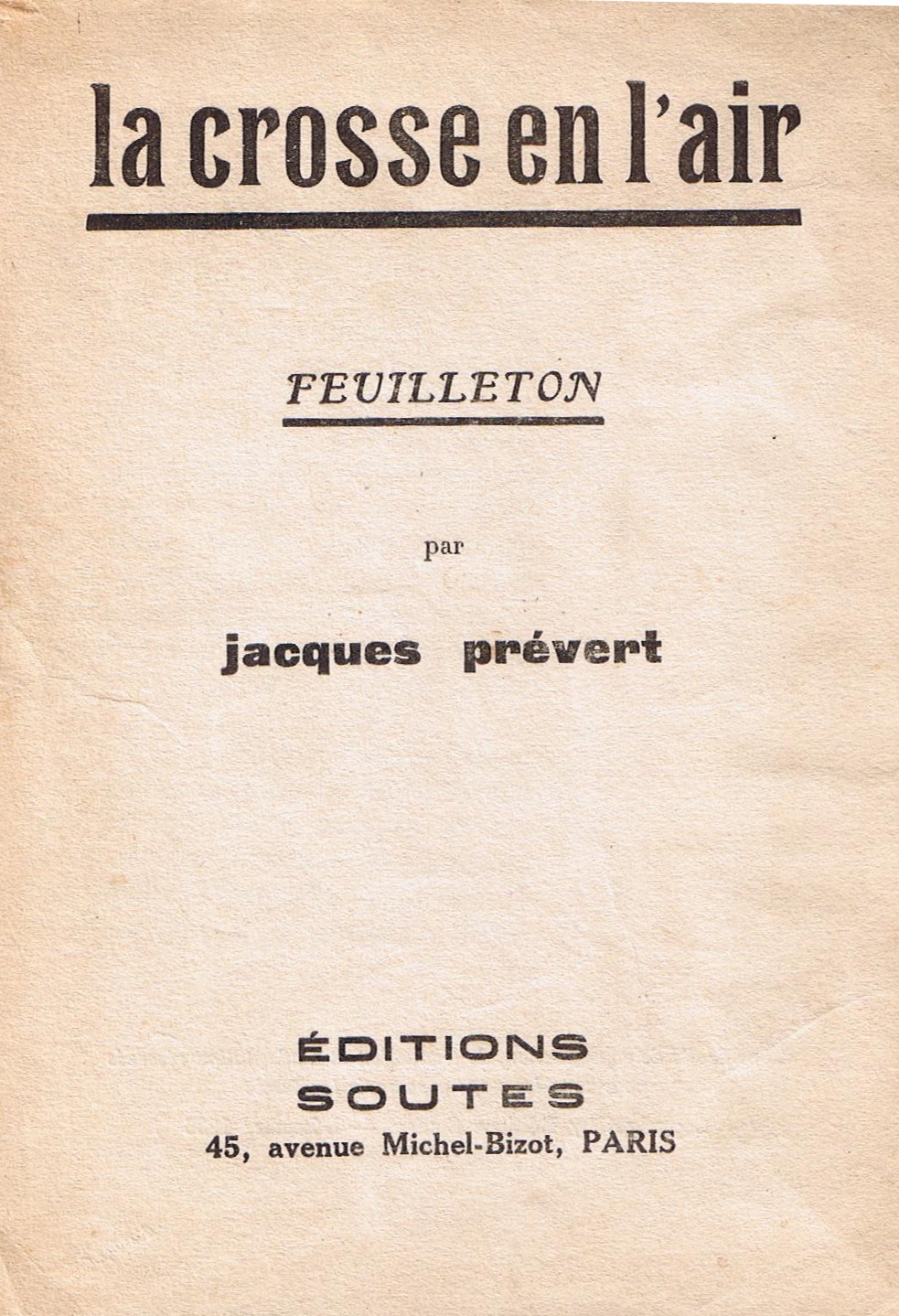
La Crosse en l'air, indictment of the collusion of Church and fascist ideology, is part of the famous collection Paroles (1946). But the original edition of this "feuilleton" is from 1936, published by les Editions Soutes. This was the period of the Popular Front, the Spanish Civil War. Jacques Prévert, since 1932, is part of the Groupe Octobre, a theater company, for which he wrote plays and spoken choirs. If he is not a member of the Communist Party, he joined the revolutionary struggle. La Crosse en l'air, whom title is quote from the Internationale, provides a series of virulent humorous portraits, figures from Paris and Rome, during a the journey of a funny night watchman who goes tell the Pope what he trully thinks.
Below, this famous text told by  Serge Reggiani, who was also a member of the Groupe Octobre.


Currently, the librairie Loliée offers :
  • PREVERT (Jacques). La Crosse en l’air. Feuilleton. Paris, Éditions Soutes, 1936, booklet in-12, Rare first edition.

December 02, 2011

Catalogue : a N.R.F/Gallimard selection

As a tribute to Gallimard, which celebrate their 100th anniversary this year, especially to the N.R.F. collection, our bookshop offers a selection of books published in the format in-4 tellière, a special format used in the beginning of the previous century.

a N.R.F selection

October 27, 2011

Facile : an exceptional encounter between Paul Eluard and Man Ray

Facile is one of those books that mark time and which go through decades. Outcome of the collaboration between Paul Éluard and Man Ray, under the aegis of the surrealist publisher Guy Lévis-Mano, the book gives 12 poems accompanied by 12 heliogravures centered on the figure of Nusch Éluard, muse and wife of the poet. The harmonic resonance that surfaces from these pages builds an eroticism that has lost none of his poetic and visual enchantment.


 Currently, the librairie Loliée offers :
  • [MAN RAY] - ÉLUARD (Paul). Facile. Paris, G.L.M., 1935. small in-4° in leaves, illustrated cover. First edition of 12 poems by Paul Éluard illustrated in text with 12 heliogravures by Man Ray of Nusch Éluard's body. Limited to 1 225 copies. One of the 1 200 copies on velum paper.

October 21, 2011

Catherine Pozzi : the purity of classical poetry

It is in 1987, with the publication of her journal, that the work and the character of Catherine Pozzi (1882-1934) is rediscovered. Born into an aristocratic and wealthy family, the young woman, bright and well-educated, met at home José-Maria de Heredia, Paul Bourget. After studying with tutors, she completed her education spending one year at Oxford. At 25, she married the succesful playwright Edouard Bourdet, and of that consensual union, was born a son, Claude. A year after ther birth, the young mother experiencing the first symptoms of tuberculosis. Catherine Pozzi resumed her studies and got the baccalaureate at the age of 37. In 1920, she began a relationship with Paul Valéry that lasted 8 years. The important correspondence between the two lovers, published by Gallimard in 2006, shows the the tumultuous of the relation and also the influence that the author had on Catherine Pozzi's work. The poet died in Paris in 1934, undermined by disease and drugs.

Of her publications, essentially posthumous, we note, in addition to her journal, her correspondences with Jean Paulhan and Rainer Maria Rilke. If her work is the reflect of a time and of her skills, her poetry, although dazzling, is marked with a classicism and purity worthy of the greatests. The collection Poèmes, published in 1935, gives a reading of six pieces ; the last "Nyx" ("night" in Greek) was composed at one go, a month before the death of the poet :
O you, my nights, O long-awaited black-
ness, O proud country, O obstinate sec-
rets, O long looks, O thundering clouds
O flight beyond skies which are closed

O great desire, O scattered surprise
O beautiful journey of th’ enchanted sprite
O worst evil, O grace that flies
O open door where we enter night

I don’t know why I die today
Before th’ eternal rest above.
I don’t know for whom I’m prey
 I don’t know for whom I’m love.
Currently, the librairie Loliée offers :
  • POZZI (Catherine). Poèmes. Paris, Mesures, s.d. [1935], booklet in-8. First Edition. Limited to 410 copies, one of the first 10 on Holland paper.

October 14, 2011

Discovering Baudouin Luquet

Baudouin Luquet, born in 1939 in Amiens, where he began studying at the Fine Arts School, went in Paris at the Ecole Nationale des Arts Décoratifs. There, He followed the class of Marcel Gromaire and graduated in 1961. At that time, he painted mostly landscapes. He completed his education by spending a year at the Fine Arts School of Krakow. On his return, he produces "black books" where he draws alternately human figures, circles, trees and compositions in the style of that of Alberto Magnelli. He tries to move away from figuration and, throughout the 60s, his experiences led him to paint landscapes where colored field and geometric figures tend to be a "state" of nature.

Baudouin Luquet, then, eliminates any reference to reality and moved into abstraction. He realizes, in 1975, the series: Tribute to Mallarmé, Samples, Instants, and in the 80's, In Suspense.  These "assemblages" are run from preparatory drawings on paper or can be traced directly to the walls of the studio to include pre-thought.


Baudouin Luquet also produces photomontages that combine photographs and drawings. The image (shots executed during his travels in Italy, Tunisia, Spain) is repeated and assembled differently from the original pattern. The identity of the picture is lost to become a structural element of the set. These photomontages evoke the dynamics of "visual images" of Moholy-Nagy.


Currently and till the 24th of October, the library Loliée offers an exhibition of flyers "caviardés", executed in the 60, and "folds" drawings (in the 70s) presenting the work of the artist, based on transformation of the support and linear and geometric construction.

September 29, 2011

John Lennon & Yoko Ono : He Stands in a Desert Counting the Seconds of His Life


This frame is from the Jonas Mekas film He Stands in a Desert Counting the Seconds of His Life (1965/1986) presented in 1986 at the Berlin Film Festival. Experimental work, it is composed of 100 vignettes that do not last more than 2 minutes. The couple John Lennon and Yoko Ono pray before the lens of a Polaroid. The picture was sent to the artist and gallerist George Maciunas, Lithuanian-born as Mekas, to beg him to come to their party. At the time Maciunas, principal founder of the Fluxus movement, was working  with the former Beatles and his partner.

Currently, the librairie Loliée offers : 
  • [FLUXUS] Lennon (John) et Ono(Yoko). Original frame from the movie  He Stands in a Desert Counting the Seconds of His Life de Jonas Mekas. Edited in the 80's, 20 x 25.5 cm. Descriptive tag on the back.

September 14, 2011

Alberto Moravia : purveyor of tales

Alberto Moravia (1907-1990) was an iconic figure of modern literature that marked the 50s and 60s. Suffering from tuberculosis, he never finished his studies. Perhaps that explains his thirst for knowledge. He has apprehended the mains currents  of his time (surrealism, existentialism, psychoanalysis) and rejuvenated literature, sometimes making some scandal, to address three main themes: fascism, bourgeoisie and  male/female relationships. His work finds a particular resonance with filmmakers who relay the richness of his view on society: Two Women (1960) De Sica, Contempt (1963) Godard or The Conformist (1970) Bertolucci.


Published in Italy in 1941, The Fancy Dress Party (La Mascherata) is a farce in which Moravia, mixing comic opera love and dictatorship, criticizes Mussolini fascism  (see a summary below published by Gallimard) :

 General Tereso hated the Duchess Gorina, in which he saw embodied all the pride, ignorance, corruption and vanity of the old nobility. Gorina invited him  to a fancy party and he made his usual answer: to his great regret, the affairs of the state forbade him to indulge in this kind of distractions.
The Duchess, impassive and haughty, dropped casually  that this refusal would distress the Marquise Fausta Sanchez, who hoped to meet him at the festival. Tereso, who  chased  for months and in vain Fausta, felt at that name his heart, despite his age and his experience, pumped with juveniles beatings  in his chest.
"I understand," thought Tereso, "the price of Fausta is my first participation in the party".
More the plot advances and  more the quadrille bteween the protagonists slides to a dance of death. Satire is blatant and the novel was censored. It was not until 1950 that the book was published in France.

Published later (1967 for Italy and 1968 for France), Command, and I Will Obey You (Una cosa e una cosa) is a collection of short stories in which Moravoia express is taste for caricature, sometimes to surrealism.  In "The Law of Laws", the protagonist, Ettore, has the sensation that a bomb exploded in his head. If there is no external changes, he can no longer do anything unless he finds a law or rule, or a standard indicating how he should behave.

In one of his last interviews, given to the Magazine Littéraire in November 1990, Moravia recall with simplicity: "My goal is to write a fable and, pursuing this story, I come into contact with the culture of the time."

Currently, the librairie Loliée offers : 
  • Moravia (Alberto). Le Quadrille des masques (La Mascherata). Traduit de l’italien par Armand Pierhal et Viviana Paques. Roman.  Paris, Gallimard "Du monde entier", 1950, in-12. First french edition. One of the 250 copies on Lafuma vellum, only deluxe paper.
  • Moravia (Alberto). Une Chose est une chose. Nouvelles. Traduit de l’italien par Simone de Vergennes. Paris, Flammarion "Lettres Etrangères", 1968, in-8. First french edition. One of the 30 copies on Alfa vellum, only deluxe paper.

September 01, 2011

Chantiers : the Carcassonne magazine of Joë Bousquet

It is in the darkness of his room where he lived as cloistered that Joë Bousquet (1897-1950) launched the magazine Chantiers in 1928. At the initiative to this regional publication, two lifelong friends : the poet of classical expression François-Paul Alibert and the philosopher Claude Estève who taught at the city high school. Others friends from Carcassonne contributed to the magazine, Ferdinand Alquié, Henri Féraud, Maurice Nogué and René Nelli, who was the director ; but also friends from the capital, Paul Eluard, Michel Leiris.

If the filiation with Surrealism marked the initial spirit of the magazine, the influences multiplied in contact with other publications of that time such as Les Cahiers de l'Etoile of Carlo Suares, Le Grand Jeu of Daumal René and Roger Gilbert-Lecomte, and of course Les Cahiers du Sud of  Jean  Ballard and André Gaillard.

In nine issues on almost two years, Chantiers offers a variety of styles, mixing different currents of that time. 

Currently, the librairie Loliée offers : 
  • [REVUE] Chantiers. N°1 to 9, january 1928 – july 1930. Carcassonne, [dépôt général : Paris, Gallimard], 9 issues binded in an in-4 volume, half-morroco black, dos lisse, original covers for 5 issues (A. Lobstein). Complete set of the 9 issues of which 4 in facsimile of the rare magazine supervised by René Nelli et Joë Bousquet.

August 03, 2011

Annual Closing

Dear readers,
The bookshop will be closed from August, 04 to August, 29.

July 27, 2011

The Approximate Man of TristanTzara

Published in 1931, L'Homme Approximatif (The Approximate Man) is a pivotal text in the work of Tristan Tzara. Written between 1925 and 1930, this poem is at the crossroads of the revolutionary Dadaist period and the Surrealist growth. One can find in this work, without punctuation or capitalization, the struggle of the author : a desire to reclaim the language to better fight a civilization that restricts men, prevents them to overtake theirs limits. The man he described is approximate in the way that he is thrown at random in the world, inaccessible to himself as to others, uncertain of the meaning of his life, yet passionate.The goal of the poem is to imagine a new man who lets intuition and spontaneity guide him through life.
je parle de qui parle qui parle je suis seul
je ne suis qu'un petit bruit j'ai plusieurs bruit en moi
un bruit glacé froissé au carrefour jeté sur le trottoir humide
aux pieds des hommes pressés courant avec leur morts autour de la mort qui étend ses bras
sur le cadran de l'heure seule vivante au soleil
Currently, la librairie Loliée offers : 
  • Tzara (Tristan). L'Homme approximatif. Paris, Editions Fourcade, 1931, in-8, Bradel binding, plats, original covers. First edition. Limited to 510 copies, this one on  "vélin bibliophile".

July 07, 2011

Jules Supervielle : a quiet strenght

Jules Supervielle (1884-1960), raised between France and Uruguay, is a man between the two worlds, both in his life and in his work. Contemporary of the Surrealists, he does not adhere to the movement, rejecting the too much emphasis given to unconscious writing. His poetry iwants to be humanist, in a simple and transparent way, and mixes everiday life with a marvellous aprehension of scenery.  Childhood and death are two recurring themes of his work (he lost his parents in a tragic accident while he was still a baby). His early writings are influenced by a Larbaud or Laforgue. He develops a quiet lyricism that addresses the great mysteries of the universe with humility. Poetry, stories, theater : his work breaks with conventional models while maintaining a commitment to accuracy and delicacy in his use of language.

Currently, the librairie Loliée offers :
  • Les poèmes de l'humour triste. Ornés de dessins inédits par Messieurs André Favory, André Lhote et Dunoyer de Segonzac. Paris, la Belle Edition, 1919, tall in-8. First edition with original illustrations. Limited to 315, this one on Arches paper. 
  • Le Survivant. Paris, Gallimard, 1928, in-4 tellière. First edition. One of the 110 copies in-quatro tellière. 
  • Boire à la source. Confidences de la mémoire et du paysage. Paris, Editions Corréâ, 1933, in-12. First edition.
  • L'Arche de Noé. Paris, Gallimard, 1938. Press copy with a dedication to the French writer Yves Gandon.
  • Oublieuse Mémoire. Paris, Gallimard, collection "Métamorphoses", 1949, in-12, broché. Edition originale. Mention fictive d'édition. 
  • Shéhérazade. Comédie en trois actes. Paris, Gallimard, 1949, in-12. Editin originale. Un des 8 premiers exemplaires sur Hollande. 
  • Premiers Pas de l'Univers. Contes. Paris, Gallimard, 1950, in-12. First edition. One of the 15 first copies on Holland paper.
  • Le Voleur d'enfants. Comédie en trois actes et un épilogue. Paris, Gallimard, 1949, in-12. First edition. One of the first 8 copies on Holland paper.  

July 01, 2011

Eccentric Sensoriality : last book of the Dadaist Raoul Hausmann

Founder of the Dada movement in Berlin, Raoul Hausmann (1886-1971), born in Vienna, is one of the first signatories of the Manifesto. His art, described as degenerate by the Nazis - he then left Germany to settle in France, is first experimental. Hausmann builds a poetry made up of sounds and onomatopoeia that he theorizes in the text "Optophonetics" (published in the journal "MA" in 1922). He has been the first to practice the art of collage, combining texts, fragments taken in the press, drawings and photographs. Based in Limoges in 1944, Hausmann will remain there till his last days .
Published in 1970 in a bilingual edition, Eccentric Sensoriality  is the last book written by Hausmann. It presents two major texts : the reprint of "Optophonetics" and therefore "Sensoriality eccentric" an essay in which the Dadaist has a pessimistic view of the modern civilization. He attacks the Homo sapiens who invented the capitalist dictatorship and limited knowledge to a purely materialistic level . Violent critique of progress, this utopic work hopes for the advent of a new man with an "eccentric sensoriality", a mental energy transcending the limits of the body and mind.
The book is illustrated by Jefim Golyscheff (1897-1970), Ukrainian painter and composer based in Berlin in 1909. Friend of Raoul Hausmann from the very beginning of Dada, he will take his distance from the movement in 1922 to get closer to the Bauhaus. Forced to flee the Nazi Germany, he moves to Spain and Brazil. He comes back in France in the 60's.


Currently, the librairie Loliée offers : 
  • [GOLYSCHEFF (Jefim)] – HAUSMANN (Raoul). Sensorialité excentrique 1968.69 précédée de  Optophonétique 1922. Cambridge, Blackmoor Head Press, collection « OU » 1970, in-4 in leaves, red illustrated folder, black case noir with, on the first cover, a collage made with a photographic portrait of the author, the name of the author and the number of the book.  First edition. Bilingual text. English version translated by Jean Chopin. Limited to 440 copies, one of the first 40 copies on « Hayle » paper signed by the author and with 2 original silkscreens numbered and signed by Jef Golyscheff.

June 23, 2011

The controversy Sexus, first novel of the famous Henry Miller's trilogy

"The Rosy Crucifixion" is the second trilogy of Henry Miller (1891-1980), writer who became a controversial symbol of the Beat Generation. It took more than a decade for Miller to complete this collection began in 1949 with Sexus that delivers the details of his divorce from his first wife to his second marriage with June Miller. The story takes place in New York. The book is full of portraits, memories and offers an insight into Miller's ambition who struggled to become a writer. As usual, Miller exposes erotic passages to establish his thoughts. The french publication was turbulent. The editor, Maurice Girodias, head of Olympia Press publications founded by his father who had taken the risk to publish Tropic of Cancer in 1934, created the Editions de la Terre de Feu in the sole purpose of publishing the translation of Sexus. The novel suffers censorship and falls under the 1881 law, extended in 1945, to foreign works  "cataloged libertine." Girodias is threatened to be jailed. The first edition of the french translation, published in 5000 copies, was cut of its pornographic passages. Only the 200 not-to-be-sold copies and the 300 copies reserved for press remained uncensored.

Currently, the librairie Loliée offers :

  • MILLER (Henry). La Crucifixion en rose. Sexus. Livre premier. Traduit de l'anglais par Jean-Claude Lefaure. Paris, Editions de La Terre de Feu, 1949, 2 volumes, in-12, covers. First edition of the french translation. One of 300 copies reserved for press.